


A good Spyfall player can answer without naming the location. A great one understands exactly how much information that answer gives away. Once everyone at the table knows the basic tricks, winning becomes less about catching an obvious bluff and more about controlling what others can infer.
Experienced players need sharper questions, better recall and tactics that change as the clock runs down. Whether you receive the spy card or a location, these strategies will help you rely less on hunches.
Think About Information, Not Just Suspicion

The central challenge in Spyfall is that the same sentence reaches two different audiences. Players who know the location can interpret a subtle reference, but the spy is trying to use that reference to identify the setting. The strongest contribution tells your team something without narrowing the spy’s choices too far.
Consider a round set at a circus. Saying “There are performers here” identifies the sort of place far too easily. Saying “Some people have a much more demanding day than others” may reassure informed players while remaining compatible with a theatre, film studio or sports venue.
Before speaking, ask yourself three things:
- Will another informed player understand why this answer fits?
- How many possible locations would still fit after I say it?
- Am I adding new information, or repeating what everybody knows?
This is your information budget. Spend it on statements that test knowledge, not on details that hand the spy a solution.
Design Questions With Two Levels of Meaning
Beginners tend to ask either obvious questions or ones so vague they test nothing. Advanced questioning sits between those extremes. The question should have a natural interpretation for somebody who knows the location and several plausible interpretations for somebody who does not.
A useful method is to progress from broad questions to more demanding ones only when the table has gathered enough evidence. Do not increase specificity automatically: an uncertain spy may benefit more from your late question than your team does.
| Stage | Example question | Strategic purpose |
|---|---|---|
| Opening | “Would people choose to come here?” | Tests the reason for visiting |
| Opening | “Would you expect to wait around?” | Establishes routine without naming objects |
| Middle | “Does preparation matter more than experience here?” | Tests an informed interpretation |
| Middle | “Would a first-time visitor need guidance?” | Separates types of places |
| Late | “Would your role change how you spend the day?” | Tests deeper knowledge where roles are in use |
| Late | “Could one mistake interrupt everyone else?” | Forces a meaningful judgement |
No advanced Spyfall question is universally safe. Its value depends on the remaining locations and earlier clues. A clothing question might reveal everything after somebody mentions unusual equipment.
Expert tip: Ask about consequences, expectations and social rules before asking about physical objects. Those subjects often test understanding without giving away a distinctive prop.
Control the Question Route
Who receives the next question matters almost as much as what is asked. Under the original rules, the person who answers asks the next question, but cannot immediately question the person who just questioned them. You therefore cannot cross-examine somebody with an instant follow-up; you must think one or two turns ahead.
Send questions to players whose earlier contributions need testing, but remember that they will then control the next target. Asking a suspected spy may give them the opportunity to question an easy opponent and collect useful clues.
There are three practical ways to use the route:
- Broaden coverage. In the first part of the round, favour players who have said little. Silence gives the group no evidence.
- Create delayed comparisons. If somebody makes a questionable claim, arrange for a different aspect of the setting to be tested on a later turn.
- Avoid accidental rescue. Do not feed a struggling suspect an obvious question that lets them repeat everyone else’s clues.
The aim is not to form a rigid interrogation plan. It is to stop the conversation drifting towards whichever player has the most confidence.
Build an Evidence Ledger in Your Head
Good players remember suspicious statements; excellent players also consider innocent explanations. One awkward answer should not become a certainty, especially when roles or interpretations differ.
A small mental ledger is enough. Keep track of the original claim, whether it fits the location, and whether the person introduced knowledge independently.
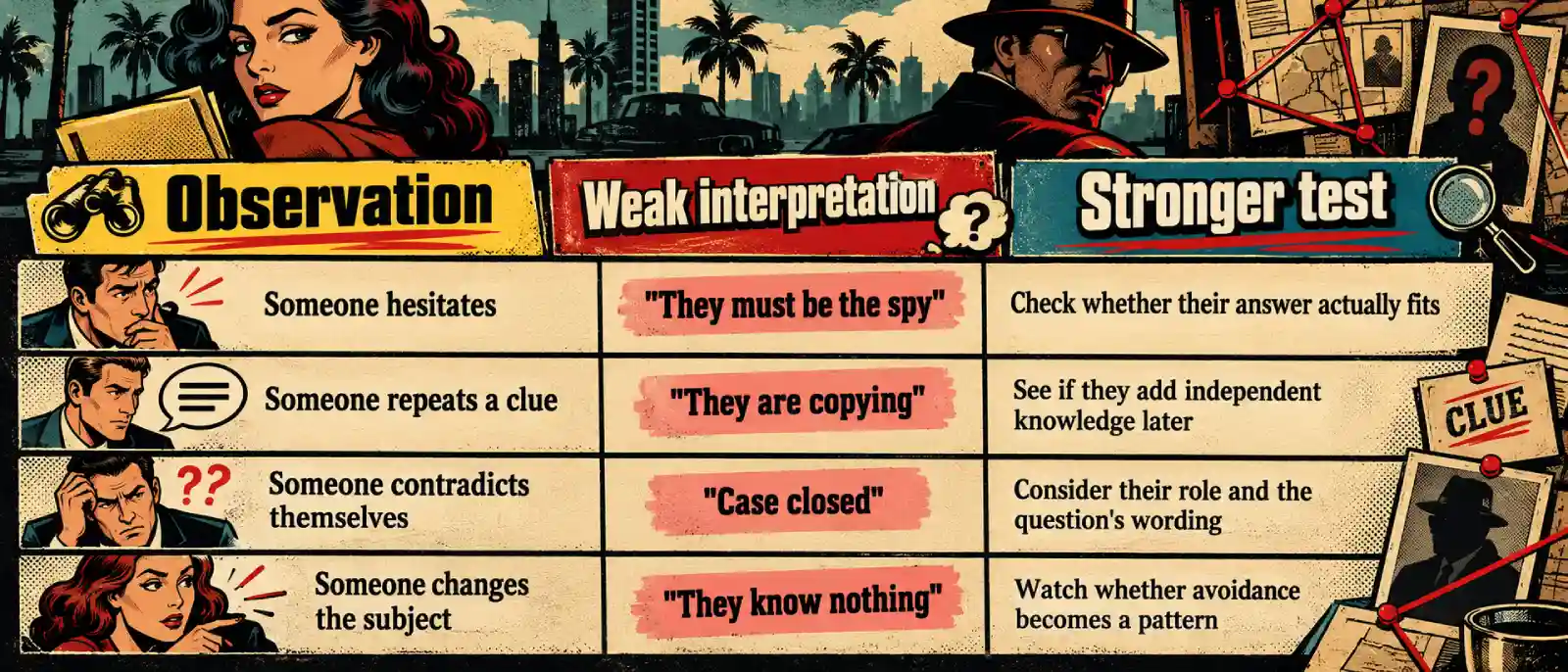
Do not assign invented percentages to people after two sentences. Instead, update your suspicions when new evidence arrives, including evidence that points away from your favourite suspect.
Use Role-Based Play Without Confusing the Group
Location cards can also specify roles, and the original rulebook recommends agreeing before play whether everyone should answer from that character’s perspective. For experienced groups, doing so adds useful complexity. A performer and a visitor at the same circus might give different answers about working hours, clothing or why they are there.
This creates a trap for careless accusations. An answer can conflict with your personal experience of the setting yet remain perfectly consistent with another role. Before accusing somebody, ask whether you have mistaken a difference in perspective for ignorance.
As a non-spy, use your role to make answers distinctive but not transparent. As the spy, remember that confident role-play may be genuine knowledge rather than evidence that someone knows a special clue.
Track Candidate Locations When You Are the Spy
When playing as the spy, your most important task is not sounding clever. It is reducing the number of plausible locations while keeping enough flexibility to survive questions. Rather than jumping to the first location that comes to mind, maintain a shortlist and remove candidates only when new evidence clearly rules them out.
Imagine the clues suggest staff, queues and occasional announcements. An airport, railway station and hospital could all remain possible. A question about whether visitors normally choose to be there might narrow the options, but it will not settle the answer on its own.
Try sorting clues into categories:
- Purpose: Work, leisure, travel, treatment or an obligation.
- Access: Open to everyone, ticketed, invited or restricted.
- Duration: A quick stop, several hours or an overnight stay.
- Routine: Scheduled activity, unpredictable events or free exploration.
- People: Specialists, customers, visitors or mixed groups.
Avoid treating a single clue as decisive. A queue exists in many settings, and a uniform does not automatically mean an airport. What matters is the combination.
Bluff With Controlled Specificity
An experienced group will spot somebody who answers every question with “it depends”. They may also catch a spy who invents a highly detailed explanation. The better option is controlled specificity: make one limited claim that fits the evidence available, without adding unnecessary facts.
Suppose somebody asks whether people arrive prepared. You suspect the location involves a scheduled public activity, but you are not certain. “Some people would, although others could probably manage without much planning” gives a genuine answer without pretending to know more than you do.
When it is your turn to ask, choose questions with an informational payoff. A question about whether visitors expect to pay may separate several candidates. Asking what somebody likes most about the place could produce a vague opinion and teach you very little.
A useful bluffing rule: Borrow the level of detail used by the group, not their exact wording. Repeating another player’s phrases is easy for experienced opponents to notice.
Manage the Clock and Accusations
Timing changes the value of every decision. Early in a round, the spy knows relatively little, while the other players may have too little evidence to make a safe accusation. Later, the group has more statements to compare, but the spy has also heard more clues.
In the original tabletop rules, rounds normally use an eight-minute timer. During play, a player can stop the clock to propose a suspect; conviction requires agreement from everyone except the accused. If the timer expires, a final accusation phase follows. The spy may reveal their card and guess the location while the clock is running, but not once that time has expired. Check your online version, as voting and timing can differ.
| Situation | Better decision | Main risk |
|---|---|---|
| Early, little evidence | Keep questioning broadly | Giving away an obvious clue |
| Several conflicting answers | Compare explanations before accusing | Mistaking an innocent player for the spy |
| Spy has a strong location shortlist | Consider a timely guess | Losing on a confident but wrong choice |
| Clock nearly finished | Decide whether the group can reach agreement | Wasting the remaining chance to gather evidence |
Scoring can matter too. Under the original rules, the spy earns four points for a correct location guess or a successful false accusation against a non-spy, but two if nobody is convicted. Non-spies receive one point for a win, with two for the player who initiated a successful accusation. That makes a well-timed decision more valuable than simply appearing convincing.
Worked Example: An Experienced Spyfall Round
Imagine six players at a circus. Five know the location, one is the spy, and everyone has enough experience to avoid mentioning clowns, tents or acrobats. The first questions therefore establish expectations rather than objects.
| Exchange | What happens | Strategic reading |
|---|---|---|
| Ava asks Ben | “Would you come here on an ordinary Tuesday?” Ben: “Not usually.” | Suggests an occasional visit |
| Ben asks Cara | “Would a bad day here affect other people?” Cara: “Quite possibly.” | Fits work and entertainment settings |
| Cara asks Dan | “Does everybody have the same reason for being here?” Dan: “More or less, yes.” | Potentially weak if visitors and workers differ |
| Dan asks Eva | “Would children enjoy it?” Eva: “Some more than others.” | Useful clue for the spy, little proof of innocence |
Dan’s answer deserves attention, but an accusation would be premature. He may interpret “everybody” as the audience, not the staff. Test another aspect later without spelling out that distinction.
The spy could now be considering a theatre, circus or theme park. More answers about children or entertainment would narrow that shortlist. A better next question tests timing or responsibility.
The strongest question is not the one that makes a suspect uncomfortable. It is the one that forces a distinction the suspect cannot easily fake, without solving the location for them.
Adapt Your Strategy to the Table
Small groups make every answer more noticeable. Larger groups create more clues, but also more opportunities for the spy to copy convincing explanations.
Spyfall 2 adds the option of two spies, along with support for more players. When two spies are in play, do not assume every suspicious answer comes from the same person or that removing one suspect resolves the entire problem. Confirm the edition’s voting and guessing rules before playing.
Online games introduce another complication: typing delays and limited social cues. Put greater weight on the content of answers than on response speed, and check whether the site follows the original unanimous-vote rules or uses its own system.
Practise the Skills That Actually Improve Results
Advanced Spyfall is easier to improve when you review decisions rather than simply remembering wins. After each round, spend a minute identifying where useful evidence appeared and which answers gave the spy too much help. That is more instructive than arguing over who looked nervous.
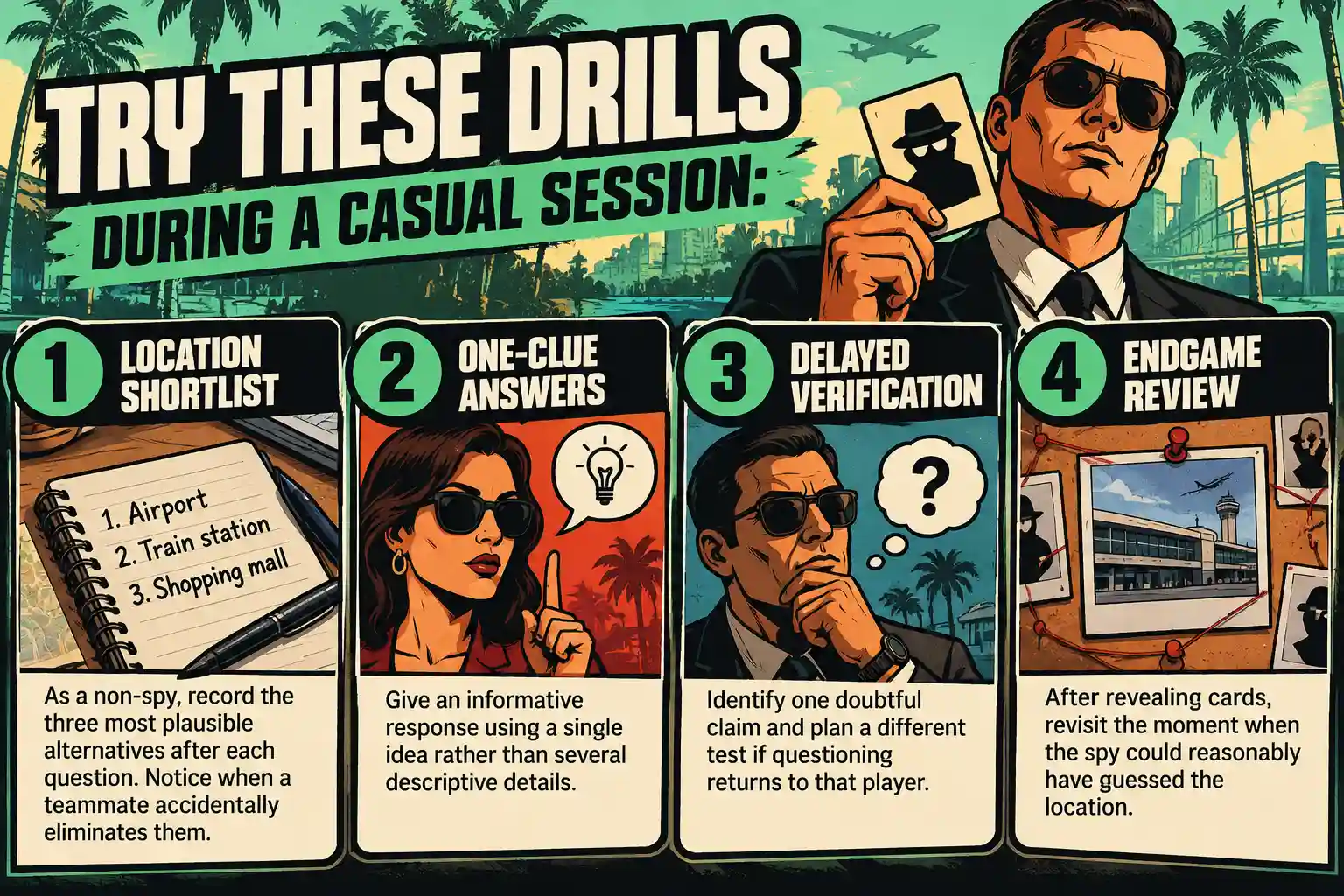
Rotate who leads the post-round discussion. Different players will notice different leaks, and a group that can admit its mistakes tends to get much better at deduction.
Final Thoughts
The difference between a competent Spyfall player and an expert is often restraint. Know when an answer reveals enough, when a question goes too far and when a suspect deserves another chance.
As a non-spy, protect the location while testing genuine knowledge. As the spy, keep your possible locations organised and take calculated risks. Winning more often starts with giving every question a purpose.
Frequently Asked Questions About Advanced Spyfall Strategy
Once everybody can bluff reasonably well, a few decisions become especially important. Here are the answers to common strategic questions.
What Is the Best Advanced Spyfall Strategy for Non-Spies?
Control the information you reveal while collecting independent evidence about other players. Ask questions that test expectations or consequences, compare answers across different subjects, and accuse only when the explanation is difficult to reconcile with the location.
How Do You Win Spyfall Consistently as the Spy?
There is no guaranteed method, but maintaining a shortlist of possible locations helps. Ask questions that divide that list, give appropriately specific answers and judge when a location guess is worth the risk of revealing your card.
Should Experienced Players Use Obscure References?
Sometimes, but only if other informed players can reasonably understand them. A reference so private that nobody recognises it gives the group no proof of your knowledge. A famous or distinctive reference might reveal the location immediately.
Is It Better to Accuse Early or Wait for the Timer?
Neither is always correct. An early accusation limits the spy’s information gathering but may rest on weak evidence. Waiting allows more comparisons, although it also provides the spy with additional clues. Consider both the evidence and your group’s ability to agree.
Do These Tactics Work in Spyfall 2 and Online Spyfall?
Information control, careful questioning and testing consistency remain useful. However, two-spy rounds and online voting systems can change the correct endgame decision. Check the rules for the version you are using rather than assuming every edition plays identically.

Born and raised in London, Paul is the Digital Strategist and Content Manager. With a strong background in multilingual content creation, he works behind the scenes to ensure players worldwide have a seamless, engaging experience while hunting down spies. When he isn’t optimizing website content or testing new web features, you can usually find Paul training at his local MMA and boxing gym, or putting his own social deduction skills to the test in a fast-paced round of our social deduction game.