


Spyfall is a popular social deduction party game that combines clever questions, bluffing and a healthy dose of suspicion. Whether you’re organising a family games night, a university gathering or an evening with friends, one of the first questions you’ll probably ask is: how many players do you need for Spyfall?
The original Spyfall board game is designed for 3 to 8 players, although many people find that 5 or 6 participants provide the most enjoyable experience. With this number, there’s enough mystery to keep everyone guessing without making conversations difficult to follow.
Larger groups can enjoy Spyfall 2, which supports up to 12 players. There is even a special two-player option in Spyfall: Time Travel.
Let’s explore the ideal group sizes, how player numbers affect gameplay and which version works best for your next games night.
How Many People Can Play Spyfall?

The number of players depends on which edition of Spyfall you’re using. While the original game has a relatively small player limit, newer editions offer additional possibilities.
Here’s a quick comparison:
| Spyfall version | Minimum players | Maximum players | Best suited for |
|---|---|---|---|
| Original Spyfall | 3 | 8 | Small and medium groups |
| Spyfall 2 | 3 | 12 | Larger parties and gatherings |
| Spyfall: Time Travel | 2 | 8 | Couples and smaller groups |
| Online Spyfall versions | Varies | Varies | Remote games and flexible groups |
Although three players are enough to start the original game, that doesn’t necessarily mean three is the ideal number.
For most groups, 5–6 players offer the best balance between suspense, conversation and strategy.
With fewer participants, identifying the spy can become relatively straightforward. With larger groups, players have more information to analyse, but keeping track of everyone’s answers becomes challenging.
Why Does the Number of Players Matter in Spyfall?
Spyfall isn’t simply about guessing who has the spy card. It’s about asking intelligent questions, interpreting suspicious answers and avoiding revealing too much information.
At the beginning of a standard round, everyone except one player receives the same secret location. The remaining participant becomes the spy and must work out where everyone else is.
For example, imagine the secret location is a hospital.

As the number of participants increases, the spy has more opportunities to gather clues. However, there are also more people watching for inconsistencies.
This relationship between information and suspicion is what makes the number of players so important.
What Is the Best Number of Players for Spyfall?
Although the game officially accommodates several group sizes, each creates a different experience.
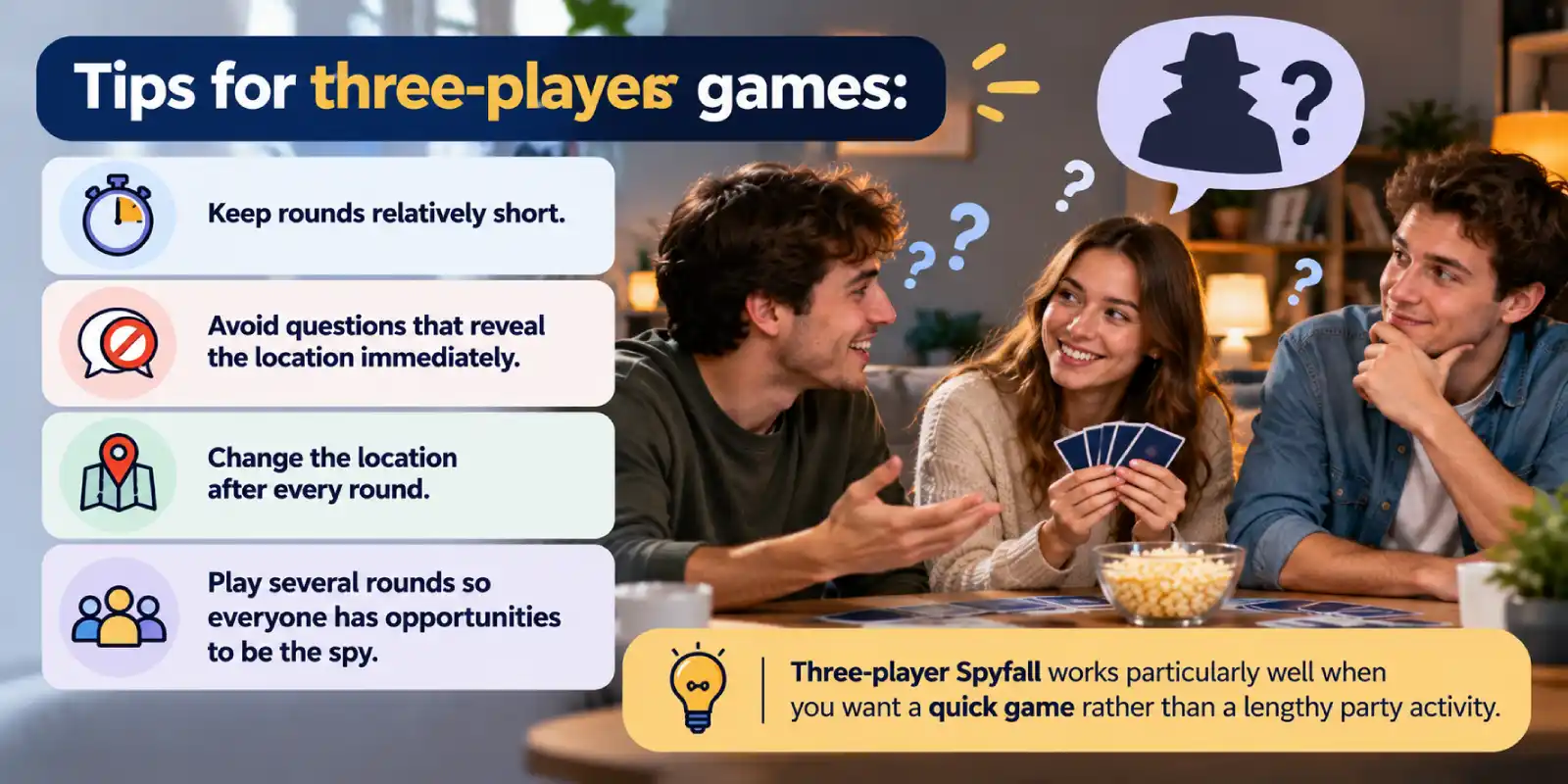
Playing Spyfall With 3 Players
Three players represent the minimum requirement for the original game.
In this arrangement, two participants know the secret location, while one becomes the spy.
The biggest advantage is speed. Rounds move quickly, everyone remains involved and there is little opportunity for conversation to become repetitive.
However, identifying the spy can be easier because there are only three possible suspects.
Playing Spyfall With 4 Players
Four players create a more interesting balance between suspicion and deduction.
There are now three players who know the location, giving the spy more answers to learn from.
At the same time, everyone has enough opportunities to observe each other’s behaviour.
This group size is excellent for families, double dates and small gatherings.
One useful strategy is to avoid directing every question towards the same person. Distributing questions helps everyone participate and makes suspicious behaviour easier to notice.
Playing Spyfall With 5–6 Players
For many groups, five or six players are the ideal number for Spyfall.
This arrangement creates enough uncertainty to make deduction interesting without overwhelming participants with information.
The spy can collect useful clues, but making a convincing answer remains challenging.
Meanwhile, other players have enough people to question and compare.
Advantages include:
- A good balance between bluffing and deduction.
- Plenty of opportunities for creative questions.
- Manageable conversations.
- A comfortable pace for beginners.
- Enough variety to make repeated rounds enjoyable.
If you’re introducing Spyfall to friends who have never played before, starting with five or six people is an excellent choice.
Playing Spyfall With 7–8 Players
Seven or eight participants create a livelier, more unpredictable experience.
With so many people contributing clues, the spy may find it easier to guess the location.
However, the larger number of suspects also makes identifying the spy more complicated.
The main challenge is ensuring everyone gets an opportunity to participate.
To keep the game engaging, encourage players to direct questions towards different participants rather than repeatedly choosing the same people.
This group size is particularly suitable for parties where everyone enjoys conversation, improvisation and friendly accusations.
Can You Play Spyfall With Just 2 Players?
The original Spyfall isn’t designed for two players.
Its central mechanic depends on uncertainty about which participant is the spy. With only two people, the conventional system of accusations and group deduction doesn’t work as intended.
However, there are alternatives.
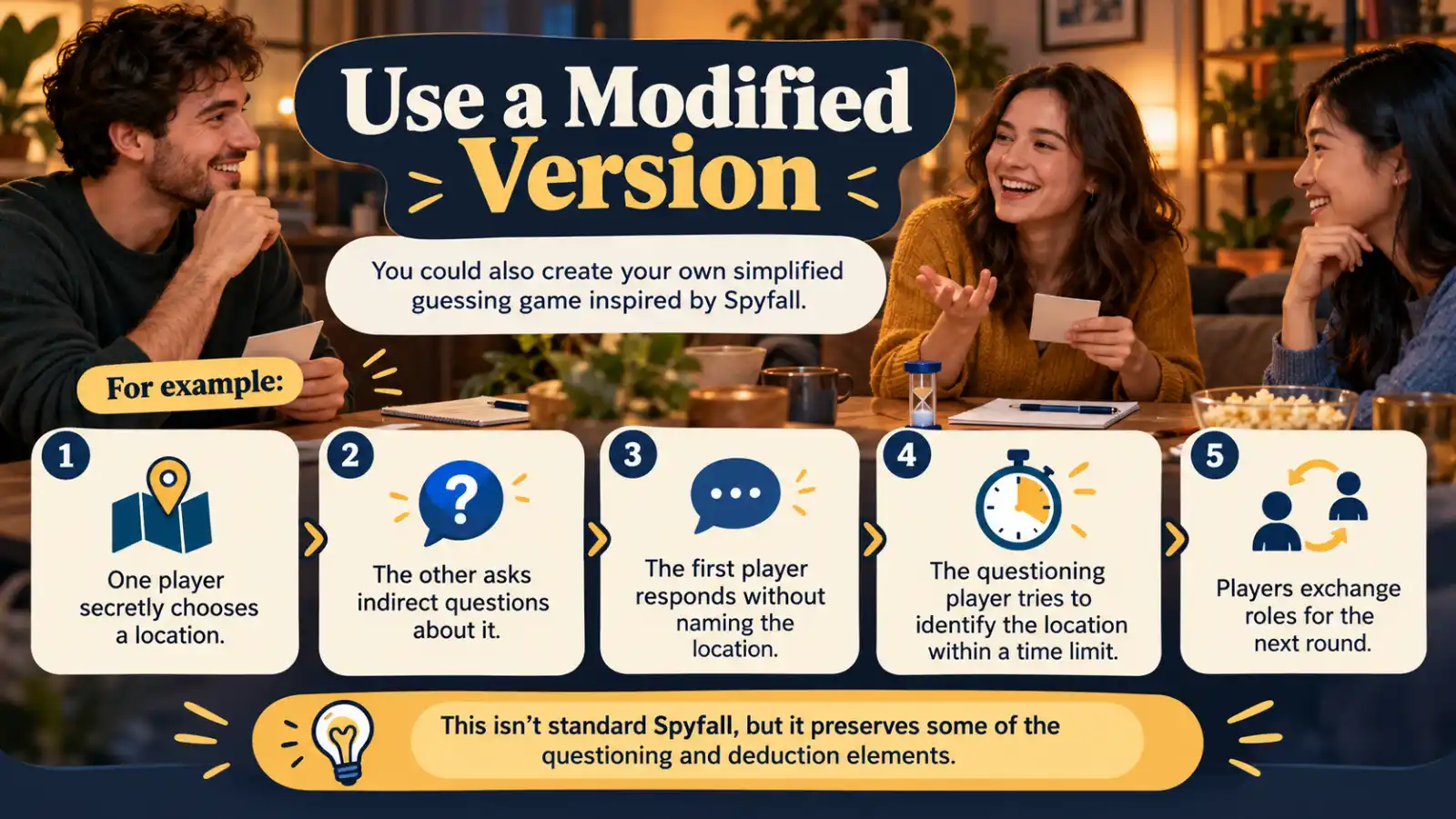
Try Spyfall: Time Travel
Spyfall: Time Travel officially supports 2–8 players and includes special rules for two-player games.
This makes it a more suitable choice for couples or friends who want to play without inviting additional participants.
Can You Play Spyfall With 9–12 Players?
Yes, but you’ll need Spyfall 2 rather than the original edition.
Spyfall 2 expands the maximum player count to 12 participants and introduces the possibility of having two spies in the same round.
This addition changes the game considerably.
With two spies, participants must consider multiple suspicious individuals while trying to prevent either spy from discovering the location.
The game’s official rules recommend two spies for groups of nine or more players.
For a full twelve-player game, two spies are required.
How Many Spies Should You Have?
| Number of players | Suggested spies | Recommendation |
|---|---|---|
| 3–4 | 1 | Keep the classic format |
| 5–6 | 1 | Ideal for beginners |
| 7–8 | 1 | Good balance for most groups |
| 9–11 | 2 | Recommended in Spyfall 2 |
| 12 | 2 | Required in Spyfall 2 |
These recommendations apply to Spyfall 2’s rules for larger groups. With seven or eight players, experienced groups can experiment with two spies if they want additional complexity.
For beginners, playing with one spy and no more than eight people is generally the easiest way to learn.
How Long Should a Spyfall Round Last?
The standard Spyfall game uses eight-minute rounds, although groups can adjust their playing time to suit their experience.
The number of participants influences how quickly everyone can ask and answer questions.
Smaller groups often benefit from shorter rounds because there are fewer people to question.
Larger groups may need more time to make meaningful accusations.
The following timings are practical suggestions rather than mandatory rules.
| Players | Suggested round length |
|---|---|
| 3–4 | 5–6 minutes |
| 5–6 | 7–8 minutes |
| 7–8 | 8–10 minutes |
| 9–12 | 8–10 minutes |
For a typical games night, five rounds provide a satisfying introduction without requiring an entire evening.
Remember that discussing accusations and preparing new rounds will add to the total playing time.
Practical Tips for Playing Spyfall With Different Group Sizes
Whether you’re playing with three friends or organising a larger party, a few small adjustments can improve the experience significantly.
1. Make Sure Everyone Understands the Rules
Before starting, explain the difference between the spy and the players who know the location.
Newcomers should understand that asking an overly obvious question can accidentally help the spy.
A short practice round is often more effective than a lengthy explanation.
2. Avoid Questions That Reveal Too Much
Suppose the location is an airport.
Asking “Which airline are we flying with?” might immediately reveal too much information.
A subtler question, such as “Would you normally arrive early?” provides a useful clue without identifying the location directly.
3. Encourage Everyone to Participate
In larger groups, confident players can dominate conversations.
Encourage questions to move around the group so quieter participants also get involved.
This creates a fairer experience and gives everyone opportunities to demonstrate their knowledge.
4. Choose Your Locations Carefully
Familiar locations are particularly helpful for beginners.
Examples include:
- A restaurant.
- A cinema.
- A school.
- A supermarket.
- A hospital.
- A train station.
Locations that everyone understands make questioning easier and reduce confusion.
More unusual settings can be introduced once the group becomes comfortable with the game.
5. Adapt the Format to Your Gathering
Spyfall works well in various social situations, but the environment matters.
For a relaxed family evening, shorter rounds and familiar locations may be appropriate.
At a university games society or a larger gathering, experienced players might enjoy more challenging locations and two-spy rounds.
For online sessions, use a version that privately distributes roles, and make sure everyone can hear the questions clearly.
Final Verdict: How Many Players Are Ideal for Spyfall?
Spyfall is a flexible party game that works across several group sizes, but five or six players offer the strongest overall balance.
Three or four participants can enjoy quicker, more focused rounds, while seven or eight create a lively atmosphere with additional uncertainty.
For groups of nine to twelve, Spyfall 2 provides an official larger-group format, complete with the option of two spies. And if there are only two of you, Spyfall: Time Travel offers a dedicated alternative.
Ultimately, the best number depends on your group’s experience, how much time you have and whether you prefer careful deduction or lively social interaction.
Whatever your group size, the most important rule remains the same: ask clever questions, listen carefully and never reveal more than you need to.
Frequently Asked Questions About Spyfall Players
What Is the Minimum Number of Players for Spyfall?
The original Spyfall requires at least three players. Spyfall: Time Travel offers a dedicated two-player variant.
Is Spyfall Better With 4 or 6 Players?
Six players generally provide more variety, uncertainty and opportunities for deduction. Four players are still a good option, especially for quicker, more focused rounds.
Can 10 People Play the Original Spyfall?
Not under its standard rules. The original edition officially supports a maximum of eight players. Spyfall 2 is designed for groups of up to twelve.
Can You Play Spyfall With More Than 12 People?
The official Spyfall 2 limit is twelve players. For a larger gathering, consider dividing everyone into smaller groups and running separate games.
Can You Play Spyfall Online With Friends?
Yes. Several browser-based adaptations allow friends to play remotely. Player limits vary between platforms, so check the chosen version before organising your session.
How Many Players Can Be Spies?
The original Spyfall uses one spy per round. Spyfall 2 allows one or two spies, making larger games more challenging and unpredictable.
Is Spyfall Suitable for Children?
The original publisher recommends Spyfall for ages 13 and over. Younger players may enjoy the concept, but the indirect questioning and bluffing can be difficult without guidance.
Do You Need a Game Master?
No dedicated game master is required in standard Spyfall. One participant deals the cards and starts the round, but they also take part as a normal player.

Born and raised in London, Paul is the Digital Strategist and Content Manager. With a strong background in multilingual content creation, he works behind the scenes to ensure players worldwide have a seamless, engaging experience while hunting down spies. When he isn’t optimizing website content or testing new web features, you can usually find Paul training at his local MMA and boxing gym, or putting his own social deduction skills to the test in a fast-paced round of our social deduction game.