


Body language is one of the most interesting parts of Spyfall. Players often reveal uncertainty before they say anything.
However, body language should always be considered together with verbal clues. A nervous person is not always the spy — they might simply be under pressure.
1. Unusual Nervous Reactions

A player who suddenly becomes uncomfortable after a question may be hiding uncertainty.
Common signs include:
- Playing with objects
- Changing sitting position
- Looking around more than usual
- Taking longer to react
- Becoming noticeably quieter
For example, if a player answers confidently throughout the round but suddenly freezes when asked about the location, that change can be meaningful.
The important factor is a change from their normal behaviour.
Some players are naturally nervous, while others stay calm even when they are the spy. Look for differences, not individual habits.
2. Avoiding or Overusing Eye Contact
Eye contact can reveal how comfortable a player feels.
A spy may avoid eye contact because they are trying to think of a safe answer. Others may do the opposite and maintain too much eye contact to appear confident.
Both extremes can be suspicious.
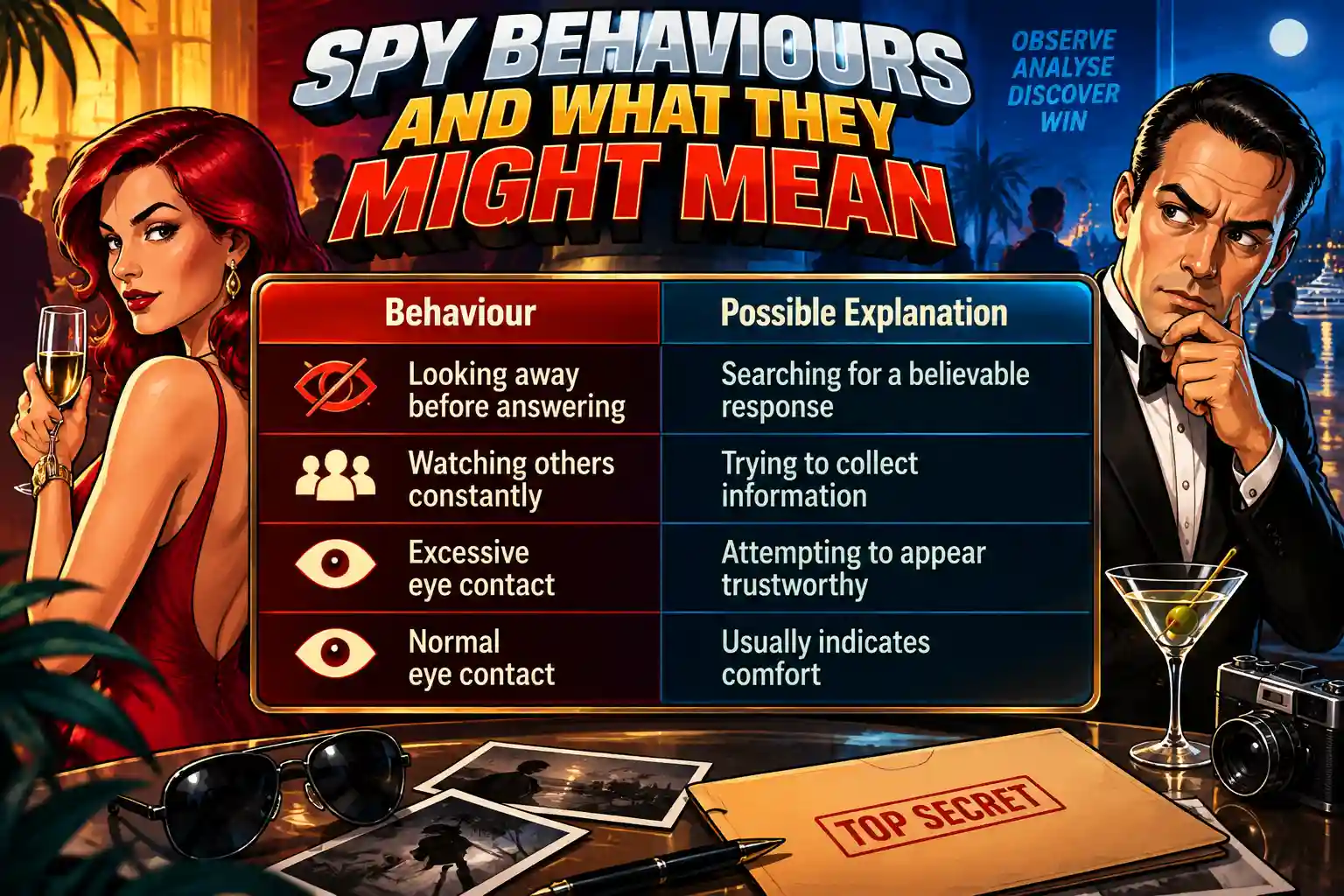
Again, eye contact alone is never proof. Combine it with the player’s answers and overall behaviour.
3. Changes in Speaking Style
The way someone speaks can reveal uncertainty.
A player who does not know the location may:
- Speak slower while creating an answer
- Use more filler words
- Avoid specific statements
- Change their usual speaking style
For example:
Natural answer:
“People usually come here for different activities depending on the time.”
Suspicious answer:
“Well… I guess people probably do different things here… maybe.”
The second answer sounds uncertain because the player is trying to create information rather than remembering it.
Verbal Clues That Expose the Spy
While body language can provide hints, words usually reveal the most information.
A good Spyfall player listens carefully to how answers are structured, not just what is being said.
Giving Answers That Are Too Generic
One of the most common spy mistakes is staying too vague.
Because the spy does not know the location, they often avoid details completely.
Examples of suspicious answers:
“It depends.”
“People do different things here.”
“It is usually normal.”
These answers can fit almost anywhere, which makes them less convincing.
A stronger answer includes a small amount of believable detail without revealing too much.
Example:
Too vague:
“People come here for different reasons.”
Better:
“It depends on the person. Some people stay longer, while others only come briefly.”
The second answer sounds more natural because it creates a realistic picture.
Asking Questions That Reveal Too Much
Spies need information, but asking the wrong question can expose them immediately.
A suspicious question is usually too direct or focuses on details that a normal player would already understand.

Copying Other Players’ Answers
Another common mistake spies make is relying too heavily on information from other players.
When a spy is unsure, they may repeat another player’s ideas to appear knowledgeable. At first, this can seem like a smart strategy, but experienced players often notice when someone is simply following the conversation instead of contributing naturally.
Pay attention when a player:
- Uses the same words as another person
- Changes their answer after hearing new information
- Avoids sharing their own perspective
- Builds every response around someone else’s statement
For example:
Player A:
“I think this place probably has a lot of visitors during the day.”
Player B:
“Yes, exactly, many visitors during the day.”
The second answer is not necessarily wrong, but it provides little original information.
A player who knows the location usually has their own understanding of the environment and can add something new to the discussion.
How Experienced Players Catch Spies
Finding the spy is not about discovering one perfect clue. The strongest players collect small pieces of information and compare them.
A single unusual answer can happen for many reasons. However, several suspicious patterns together create a much stronger signal.
Experienced players usually analyze three main areas:
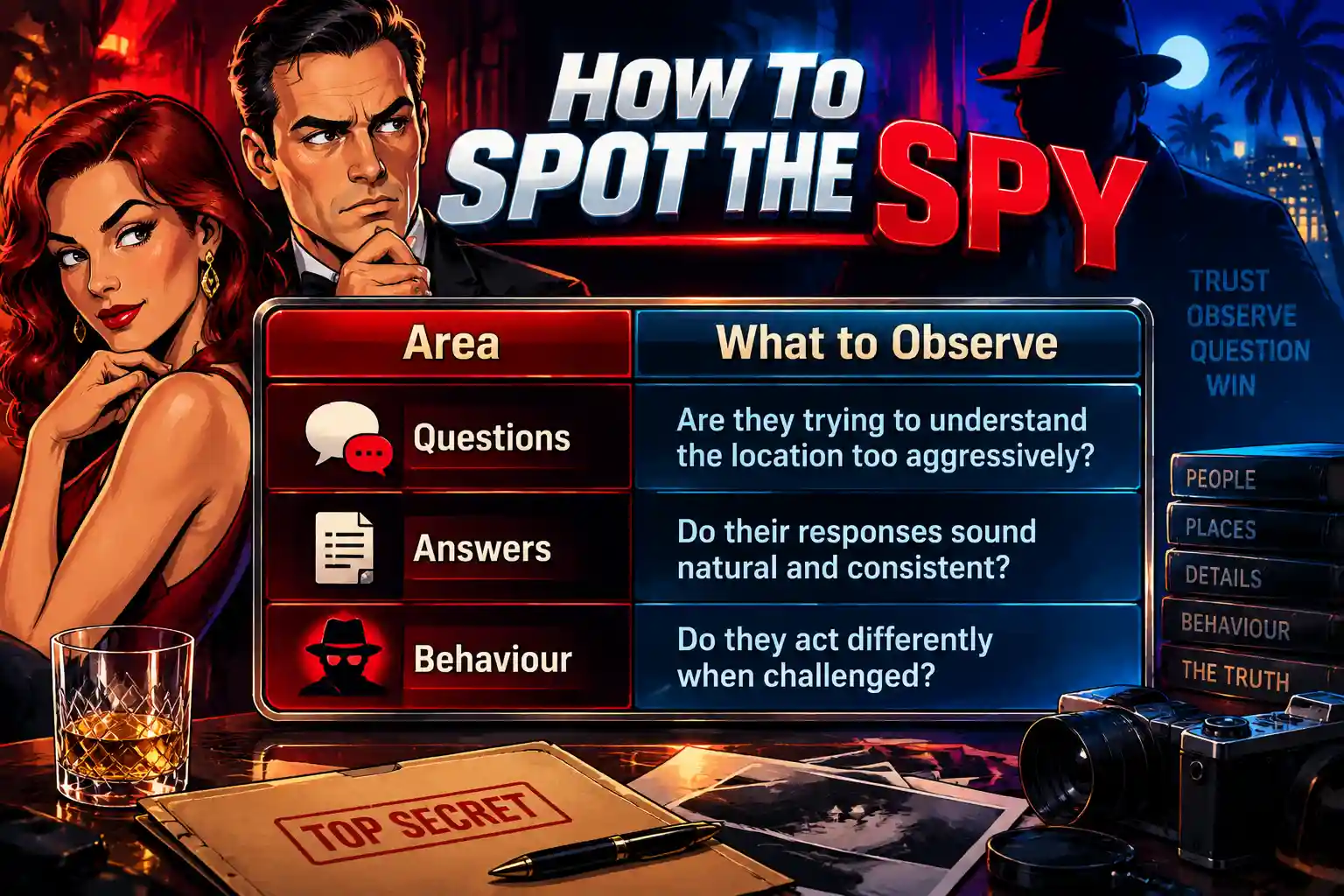
The most important question to ask yourself is:
“Does this player sound like someone who knows the location, or someone trying to guess it?”
Look for Inconsistent Behaviour
Consistency is one of the biggest clues in Spyfall.
A player may give a good answer once by chance, but maintaining a believable story throughout the round is much harder.
Watch for:
- Changing opinions after hearing others
- Contradicting previous answers
- Suddenly becoming more confident after receiving clues
- Forgetting details they mentioned earlier
For example, if someone first describes the location as quiet and later says it is usually crowded, this difference may reveal uncertainty.
However, remember that real players can also make mistakes. Always consider the whole conversation.
Compare Players’ Confidence Levels
Confidence does not mean someone is telling the truth, but uncertainty can reveal a lack of information.
Players who know the location often answer naturally because they are connecting the question with their role.
Spies usually need to create answers from limited clues.
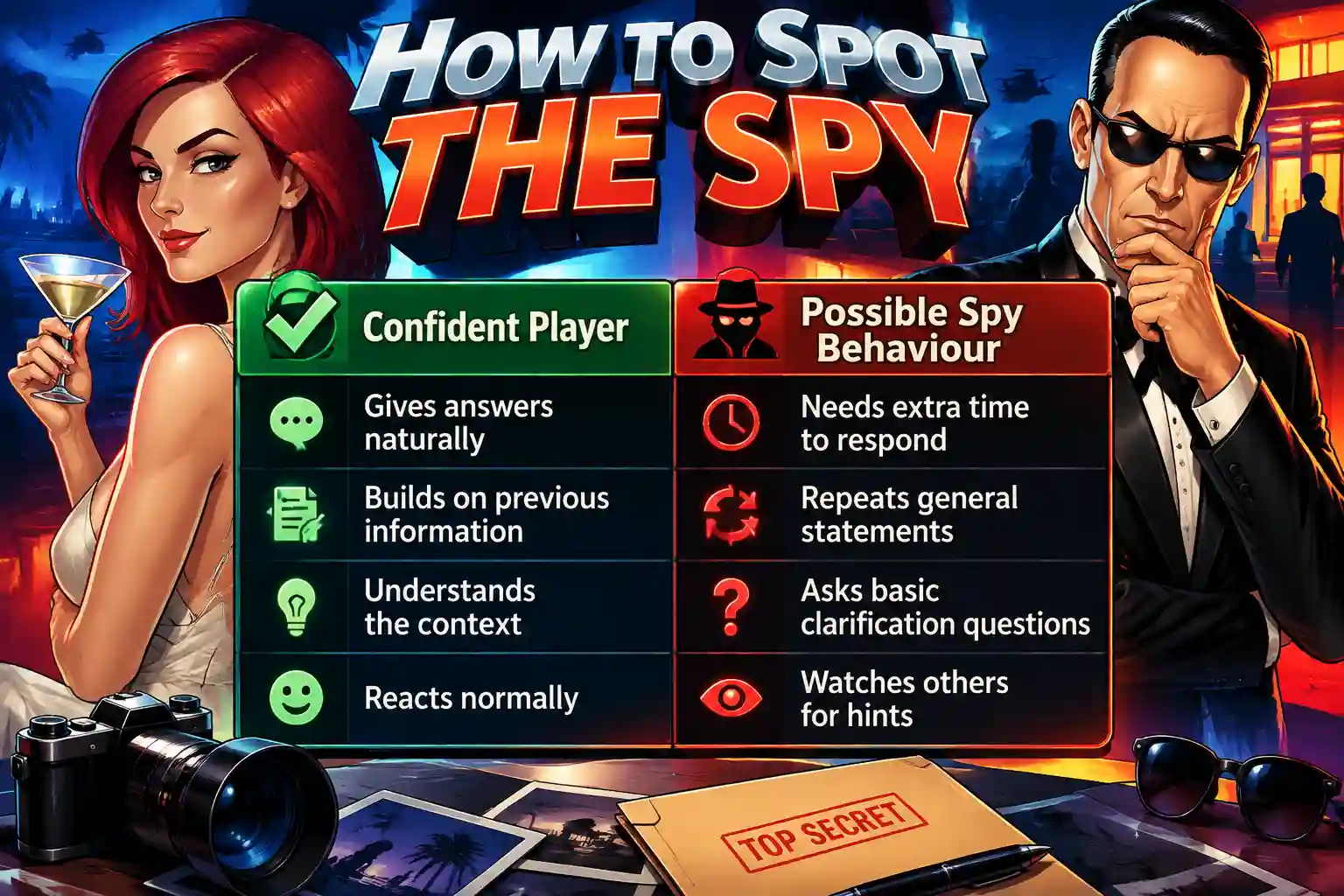
The goal is not to find the loudest or quietest player. It is to identify who seems disconnected from the situation.
Avoiding False Accusations
A common mistake in Spyfall is accusing someone too quickly.
A player can look suspicious for many reasons:
- They are new to the game
- They are naturally quiet
- They are nervous during social games
- They misunderstood the question
Good detectives do not judge based on one moment. They gather more information before voting.
Ask Follow-Up Questions Before Voting
If someone gives a suspicious answer, do not immediately accuse them.
Instead, ask follow-up questions that encourage more information.
Useful examples:
“Why do you think that?”
“Can you explain your answer?”
“Would that normally happen there?”
“What makes you say that?”
Follow-up questions are powerful because they test whether a player truly understands the location.
A spy may create one believable answer, but maintaining consistency through several questions becomes much harder.
Using Group Discussion to Reveal the Spy

Final Spyfall Detection Tips
Spotting the spy is a skill that improves with experience. The best players do not rely on guessing — they observe patterns.
Remember these key principles:
Watch behaviour changes.
A sudden difference in confidence, speaking style, or reactions can reveal uncertainty.
Listen carefully to answers.
The spy often struggles to balance being helpful and avoiding mistakes.
Pay attention to questions.
The questions someone asks can reveal whether they understand the location or are trying to discover it.
Avoid rushing decisions.
Strong accusations come from multiple clues, not a single suspicious moment.
Conclusion: Becoming Better at Finding the Spy
Spyfall is a game of observation, communication, and psychology. The spy’s biggest challenge is pretending to belong, while other players must discover who is missing important information.
The best detectives do not search for obvious mistakes. They notice small details:
- A hesitation before answering
- A question that feels unnatural
- A response that lacks confidence
- A behaviour change under pressure
At the same time, smart players avoid judging too quickly. The most successful Spyfall strategies come from combining different clues and understanding the entire conversation.
The best way to spot the spy is not to look for someone acting suspicious — it is to find the player who does not truly understand the world everyone else is describing.
With practice, sharper observation, and better questioning skills, you can turn every Spyfall round into a battle of deduction where you are always one step ahead.
FAQ: How to Spot the Spy in Spyfall
1. Can body language alone reveal the spy in Spyfall?
No. Body language can provide useful clues, but it should never be the only reason to suspect someone. Nervousness, hesitation, or unusual reactions can happen for many reasons. The best approach is to combine body language with answers, questions, and overall behaviour.
2. What is the biggest sign that someone is the spy?
One of the biggest signs is inconsistent behaviour. A spy may struggle to give answers that match the location, ask questions that reveal they lack information, or change their responses after hearing other players’ clues.
3. Should I ask direct questions to find the spy?
Usually, no. Very direct questions can reveal too much information and help the spy understand the location. The best questions are open-ended and allow players to show whether they naturally understand the situation.
4. Can a good spy avoid showing suspicious behaviour?
Yes. Experienced spies can control their reactions and give believable answers. That is why finding the spy is not about noticing one obvious mistake — it is about identifying repeated patterns throughout the round.
5. How can I become better at spotting spies in Spyfall?
The best way is to practice observation. Focus on how players normally communicate, compare their answers, and pay attention to changes in behaviour. Over time, you will become better at recognizing when someone is guessing instead of knowing.

Born and raised in London, Paul is the Digital Strategist and Content Manager. With a strong background in multilingual content creation, he works behind the scenes to ensure players worldwide have a seamless, engaging experience while hunting down spies. When he isn’t optimizing website content or testing new web features, you can usually find Paul training at his local MMA and boxing gym, or putting his own social deduction skills to the test in a fast-paced round of our social deduction game.