


Someone hesitates before answering a simple question. Another player gives a suspiciously detailed explanation, while the quietest person at the table suddenly starts asking questions. Who is the spy? More importantly, how can you tell whether someone is bluffing or simply trying not to reveal too much?
That uncertainty is what makes Spyfall such an entertaining social deduction game. Everyone is working with incomplete information, and even innocent players have good reasons to be careful about what they say. A convincing answer might come from the spy, while an awkward response could belong to someone who knows the location perfectly well.

Understanding Spyfall psychology means looking beyond nervous laughter and uncomfortable silences. The strongest players pay attention to how people answer questions, whether their statements make sense together, and how their behaviour changes as the round progresses.
In this guide, we will examine the psychological tactics behind Spyfall, the warning signs worth watching, and the questioning strategies that can help you identify the spy without giving away the secret location.
Why Psychology Matters in Spyfall
Spyfall is built around a simple imbalance of information. Most players know the location, while one person must work out where everyone is without revealing their identity. Both sides are trying to appear convincing, but their reasons for doing so are completely different.
According to the game’s publisher, Cryptozoic Entertainment, players question one another while protecting the location from the spy. In the original game, rounds typically last eight minutes. Non-spies win by identifying the spy, whereas the spy can win by correctly guessing the location or avoiding detection.
The psychological challenge comes from three competing objectives:
- For ordinary players: Demonstrate knowledge of the location without making it obvious.
- For the spy: Sound knowledgeable while gathering enough clues to identify the location.
- For everyone: Judge who appears trustworthy, despite knowing that honest players may deliberately give incomplete answers.
This creates an unusual situation in which ordinary conversational habits become part of the strategy. Someone who answers confidently might be bluffing, while a player who hesitates may simply be searching for a safe response.
The key is to distinguish behaviour that looks suspicious from behaviour that genuinely suggests a lack of information.
The Difference Between Suspicion and Evidence
A nervous player is not necessarily a spy. Perhaps they dislike speaking in front of a group, have misunderstood the question, or are worried about accidentally revealing the location.
Evidence is more useful when it connects directly to what a person should know.
For example, imagine the location is a railway station. Someone who hesitates when asked whether people are usually in a hurry might be perfectly innocent. However, a player who insists that people rarely have to think about time may deserve closer attention.
The second response creates a possible conflict with the setting itself. It is still not proof, but it gives the group something meaningful to investigate.
In Spyfall, the most useful clue is not that someone looks uncomfortable. It is that their answer becomes difficult to explain if they genuinely know the location.
How to Read Suspicious Behaviour in Spyfall
Reading suspicious behaviour requires more than watching somebody’s face. A stronger approach is to compare their questions, answers and decisions over several exchanges.
One unusual response means very little on its own. A repeated pattern of vague statements, contradictions or borrowed information can be much more revealing, particularly when other players are handling similar questions comfortably.
Common Signs That Someone Might Be the Spy
The following behaviours can raise reasonable questions, although none should be treated as automatic proof of deception.
| Suspicious behaviour | What it might suggest | What else could explain it? |
|---|---|---|
| Repeatedly vague answers | The player lacks knowledge of the location | They are protecting the location from the spy |
| Contradictory statements | Their answers are based on guesses | They misunderstood a question or are playing a different location role |
| Copying previous answers | They are borrowing information from others | Another player has already given the most natural answer |
| Excessive detail | They are trying too hard to sound convincing | They are enthusiastic or experienced at the game |
| Avoiding direct questions | They are afraid of exposing their ignorance | The question is poorly worded or too revealing |
| Sudden changes in confidence | They have learnt something useful during the round | They are becoming more comfortable with the group |
| Repeatedly targeting one player | They are trying to direct suspicion elsewhere | They genuinely believe that player is the spy |
A useful rule is to look for several connected clues rather than one dramatic moment. If a player gives an odd answer, observe what happens when they encounter a different question about the same general setting.
Why Inconsistent Answers Deserve Attention
Consistency is particularly useful in Spyfall because the location provides a shared reference point. Players may interpret it differently, but their responses should usually remain compatible with the same basic environment.
Suppose the location is a museum. One player describes it as somewhere people might spend an afternoon exploring. Later, that same player suggests that visitors normally stay for only a few seconds.
Those answers do not necessarily fit together.
The player could have a reasonable explanation, perhaps relating to their assigned role. However, the apparent contradiction gives the group a better reason for suspicion than an awkward facial expression would.
When evaluating inconsistencies, ask yourself:
- Did the player clearly understand both questions?
- Could their assigned role explain the difference?
- Is there a reasonable interpretation that makes both answers true?
- Does the player show the same uncertainty when discussing other aspects of the location?
An isolated mistake should not outweigh several sensible answers.
Why Overconfidence Can Also Be Suspicious
Players often associate confidence with honesty. Someone who replies immediately and sounds certain may seem less suspicious than a person who takes several seconds to think.
However, a spy can deliberately use confident delivery to compensate for missing information.
Pay particular attention when confidence is accompanied by answers that sound decisive but contain little substance.
For instance:
Question: “Would you expect to spend much time waiting here?”
Answer: “Definitely. That’s completely normal in a place like this.”
The response sounds assured, but it could apply to numerous locations.
A more informative answer might be:
“Sometimes, although it depends on what you’ve come here to do.”
That second response is not automatically more trustworthy, but it acknowledges a distinction that could make sense in the setting.
Can Body Language Reveal the Spy?
Body language can make a Spyfall round entertaining, but it is a poor foundation for confident accusations. Avoiding eye contact, touching one’s face or laughing at an unusual moment does not reliably indicate that someone is lying.
Research supports a cautious approach. A 2019 review by Aldert Vrij, Maria Hartwig and Pär Anders Granhag in the Annual Review of Psychology found that non-verbal signs of deception are generally weak and unreliable.
An earlier meta-analysis by Charles Bond and Bella DePaulo, involving more than 24,000 observers, found an average accuracy of approximately 54% in experimental truth-versus-lie judgements. That figure concerns deception research generally, not Spyfall specifically, but it illustrates why confidence in reading body language can be misplaced.
Physical Behaviours That Players Often Misinterpret
Certain behaviours attract suspicion because they fit familiar stereotypes about lying. They can still be worth noticing as part of someone’s individual playing style, but they need context.
- Avoiding eye contact: A player may be concentrating, shy or simply looking towards the person who asked the question.
- Nervous laughter: This could reflect amusement, social pressure or the absurdity of the situation.
- Fidgeting: Movement is common among both relaxed and anxious people.
- Long pauses: A non-spy may be carefully constructing an answer that does not reveal the location.
- Speaking quickly: Some players naturally speak quickly, especially during competitive games.
A better use of behavioural observation is to notice changes from a player’s normal style, then check whether those changes coincide with questionable answers. Even that is only a reason to pay attention, not a reliable lie-detection method.
Practical tip: If a player always speaks quietly or avoids eye contact, do not treat those traits as evidence. Concentrate on the information they provide and the choices they make.
The Psychology of Asking Good Spyfall Questions

Questions are the most important psychological tool in Spyfall. A well-designed question puts pressure on the spy’s missing knowledge while giving informed players a reasonable opportunity to demonstrate that they understand the location.
The difficulty is finding the right balance. Ask something too broad, and everyone can answer without thinking. Ask something too specific, and you may accidentally tell the spy exactly where they are.
The best Spyfall questions test knowledge indirectly.
Questions That Help Expose the Spy
These examples work across several possible locations. Their value depends on which locations are available in your game and what information has already been revealed.
| Question | What it tests | Risk of revealing the location |
|---|---|---|
| “Would you normally spend a long time here?” | Typical visit duration | Low |
| “Would people be surprised to see children here?” | Common visitors and social expectations | Low |
| “Is this somewhere you would choose to visit?” | Voluntary versus necessary visits | Low |
| “Would you expect people to be in a hurry?” | Pace and purpose of the location | Low |
| “Would you need to think about what you’re wearing?” | Clothing expectations | Medium |
| “Would it be unusual to visit alone?” | Social behaviour and group activities | Medium |
| “Do people normally pay before entering?” | Access and payment arrangements | Medium |
| “Would staff expect you to follow special instructions?” | Rules and supervision | Medium |
| “Would you expect to hear announcements?” | Environment and facilities | Medium to high |
| “What would happen if the lights went out?” | Activities and physical surroundings | Medium to high |
The risk ratings are strategic estimates, not fixed game rules. A question about announcements may be harmless when dozens of locations remain possible, but much more revealing after earlier answers have narrowed the choices.
Notice that these questions encourage players to describe how a place works rather than naming things found there.
Avoid Questions That Give Away Too Much
Some questions appear clever because only someone familiar with the location can answer them. Unfortunately, the spy is listening too.
Imagine the location is an airport.
Asking, “Would you need to show your boarding pass here?” may help distinguish informed players, but it also gives the spy an obvious clue.
A safer alternative would be:
“Would you normally need to prepare anything before coming here?”
This tests an aspect of the location without mentioning an object closely associated with it.
Good questions create a useful distinction between players while leaving several possible locations open.
Why Indirect Questions Work
Indirect questions create a particular kind of pressure. An ordinary player already knows the setting and can draw on that knowledge, whereas the spy must infer what kind of response would be plausible.
Consider:
“Would you be comfortable bringing a young child here?”
A non-spy can think about the actual environment and give a suitable answer. The spy may have to consider several possibilities at once.
The answer itself may still be ambiguous. What matters is whether it fits the other information gathered during the round.
This is why a sequence of carefully chosen questions can be more effective than one attempt to catch someone out.
How to Analyse Answers Without Revealing the Location
A good Spyfall player listens for more than individual words. The structure of an answer, its relevance to the question and its relationship with earlier statements all matter.
The goal is not to reward whoever provides the longest explanation. It is to recognise when an answer demonstrates an understanding of the setting without giving that setting away.
Look for Contextual Knowledge
Contextual knowledge is the ability to describe what usually happens at a location without explicitly identifying it.
Suppose players are at a restaurant.
Question: “Would it be unusual to spend an hour here?”
Compare these answers:
- Answer A: “No, an hour would be quite normal.”
- Answer B: “It depends on what you are doing.”
- Answer C: “Everyone normally stays for several days.”
The first two could both make sense. The third appears inconsistent with the typical purpose of a restaurant.
That does not prove the third player is the spy, but it gives the group a sensible reason to question their understanding.
Notice When Players Borrow Information
A spy who has heard several answers may gradually become more convincing. They can reuse the vocabulary, assumptions and details supplied by others.
Imagine that someone has already suggested the location involves waiting. Another player then repeatedly refers to queues, delays and patience, despite never introducing a different aspect of the setting.
That behaviour could indicate someone constructing their answers from public clues.
To test the possibility, ask a question about another characteristic, such as the expected clothing, the typical visitors or the level of noise. In ordinary play, the person answering then takes the next questioning turn, so the group may need to wait for a suitable opportunity to test that player again.
Pay Attention to Relevance
A spy may give an answer that sounds perfectly reasonable but does not address the question.
For example:
Question: “Would you be surprised if somebody arrived here wearing a suit?”
Answer: “Well, there are lots of different people everywhere.”
The statement is true in a broad sense, but it avoids making a judgement about the location.
One such response means very little. Repeatedly avoiding the actual point of a question is more useful to notice.
A Practical Example: Reading Suspicious Behaviour During a Round
Consider a six-player game in which the secret location is a railway station. Five players know where they are, and one must bluff their way through the discussion.
The players begin with reasonably broad questions. Nobody wants to reveal the location immediately, so the first few answers are deliberately cautious.
The following exchange shows how suspicion can develop.
| Player | Question or answer | What the group can learn |
|---|---|---|
| Alice | “Would being late cause problems here?” | Introduces timing without naming the location |
| Ben | “It certainly could. I’d probably keep an eye on the clock.” | Plausible knowledge of the setting |
| Ben | “Would people usually bring bags?” | Tests another characteristic |
| Charlie | “Yes, I wouldn’t find that unusual.” | Consistent, but not particularly revealing |
| Charlie | “Would most visitors expect to stay overnight?” | Tests typical visit duration |
| Daniel | “Yes, I’d say that was fairly normal.” | Potentially inconsistent with the setting |
| Daniel | “Would it usually be noisy?” | A broad question that could apply to many places |
Daniel’s answer about overnight stays may attract suspicion because it does not fit what most people would expect at a railway station.
However, there are other possible explanations. Daniel may have misheard the question, interpreted it as referring to stranded passengers, or simply made an awkward choice of words.
A sensible group would not immediately decide that Daniel must be the spy.
Instead, they would compare his answer with any earlier statements, consider whether his question demonstrates understanding, and look for another opportunity to test his knowledge.
The lesson: Strong suspicion develops from a pattern of meaningful inconsistencies, not from a single answer that sounds odd.
Psychological Strategies for Finding the Spy
Knowing what to look for is helpful, but Spyfall also rewards players who manage the flow of information. The timing of a question, the person selected to answer and the decision to accuse can all affect the outcome.
A patient player may gather more useful evidence than someone who challenges every unusual response. At the same time, waiting too long can give the spy enough information to identify the location.
1. Start With Broad Questions
Early questions should provide information without revealing the setting. At this stage, the spy has limited knowledge, so even relatively simple questions can be challenging.
Useful opening questions include:
- “Would you visit this place regularly?”
- “Would you expect to see families here?”
- “Is this somewhere people usually enjoy being?”
- “Would arriving late be a problem?”
The answers may appear unremarkable individually. Together, they begin to establish what informed players consider normal.
2. Compare Answers Across Different Topics
As the round develops, test different aspects of the location rather than repeatedly asking similar questions.
If the discussion has already covered visitors and duration, move towards clothing, expected behaviour or the physical environment.
This makes it harder for a spy to rely entirely on information gathered from previous answers.
It also helps prevent a common problem: players sounding suspicious simply because they have been asked several versions of the same vague question.
3. Watch How the Spy’s Information Changes
At the beginning of a round, the spy knows very little. Every question and answer provides another opportunity to narrow down the possible locations.
A player who struggles early but suddenly gives highly relevant answers later might have learnt enough to construct a convincing picture.
Of course, an innocent player may simply be getting comfortable.
Look at whether the player’s later answers introduce genuine knowledge or merely repeat clues that are already available to everyone.
4. Accuse When the Evidence Justifies the Risk
An accusation carries consequences. In the original rules, a successful formal accusation during a round requires unanimous agreement from the other players, excluding the accused. Local and online versions may use different voting systems.
Accusing an innocent person can hand the spy a victory, so a convincing accusation should be grounded in clear observations.
Before making one, consider:
- Does the suspect have a meaningful contradiction in their answers?
- Have they repeatedly avoided demonstrating knowledge?
- Could their responses reasonably come from someone who knows the location?
- Is another player a stronger suspect?
- How much time is left for the spy to gather information?
A weak accusation made in a hurry may be worse than taking another turn to collect evidence.
How to Bluff Successfully When You Are the Spy

The spy faces a different psychological challenge. Instead of identifying the person with missing information, you are trying to conceal the fact that you are that person.
Your strongest advantage is that other players cannot be completely direct either. They need to protect the location, which means cautious and ambiguous answers are normal for everyone.
A good spy uses that uncertainty without depending entirely on meaningless statements.
Give Plausible Answers, Not Perfect Ones
Trying to sound certain about everything is risky. When you do not know the location, making very specific claims can expose you.
Instead, give answers that fit the information already available.
If another player has mentioned that the setting is often busy, you could reasonably say:
“I’d expect it to be busier at certain times.”
That statement may fit several places and does not introduce an obviously false detail.
However, repeating this kind of answer throughout the entire round will eventually become noticeable.
The aim is to sound like a participant with an ordinary interpretation of the setting, not somebody who refuses to commit to anything.
Ask Questions That Reveal Useful Information
As the spy, questions can be even more valuable than answers. A carefully chosen question may help you distinguish between several possible locations.
Start with broad categories:
- Indoor or outdoor: What does the environment seem to be like?
- Public or private: Who would normally have access?
- Work or leisure: Why do people usually visit?
- Short or long visits: How much time do people spend there?
- Quiet or noisy: What atmosphere would be normal?
As the answers accumulate, compare possible locations rather than deciding too quickly.
For example, a place with queues, staff and announcements could be an airport, railway station or another busy public venue. You need more information before making a final guess.
Avoid Drawing Unnecessary Attention
An inexperienced spy may try to control the discussion by aggressively accusing someone else. That can work occasionally, but it can also make their behaviour stand out.
Other risky habits include:
- Answering every question with “it depends”.
- Asking questions that are so broad they provide no useful information.
- Repeating another player’s wording almost exactly.
- Inventing detailed facts about the location.
- Changing an answer to match what someone else has just said.
- Guessing the location based on one ambiguous clue.
A convincing spy participates naturally, takes calculated risks and keeps track of which locations remain plausible.
Know When to Guess the Location
Waiting can improve your knowledge, but it also allows the other players more opportunities to identify you.
Guessing too early, on the other hand, may throw away a round.
Try to identify several independent clues that point towards the same location. If the group has established something about the environment, the purpose of visiting and the expected activities, your guess will be better informed than one based on a single familiar object.
Psychological Biases That Can Lead to False Accusations
Spyfall players are not only trying to recognise deception. They are also trying to avoid fooling themselves.
The game encourages quick judgements under social pressure, making it easy to interpret ordinary behaviour as evidence of wrongdoing.
Several familiar thinking errors are particularly relevant.
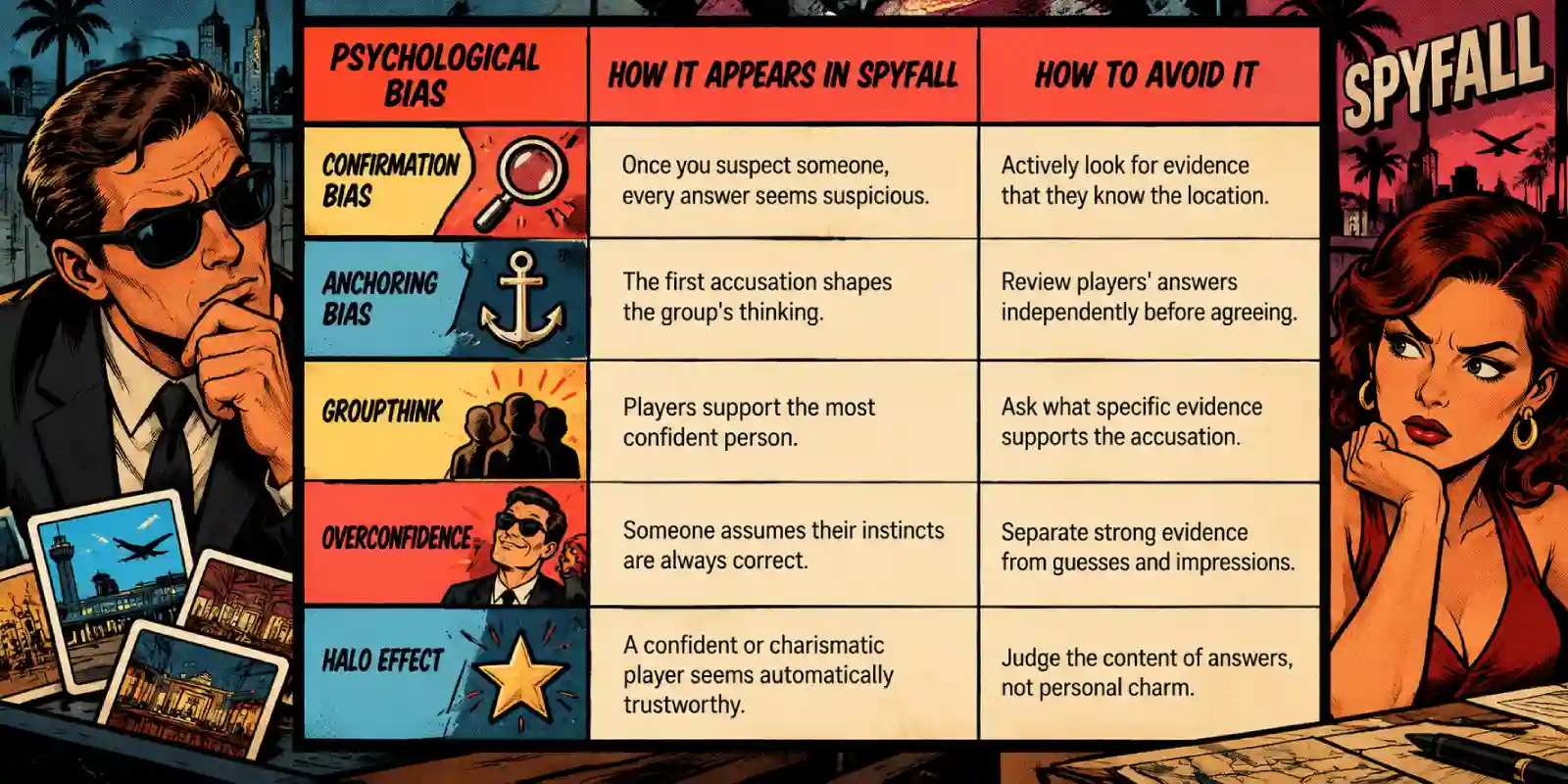
Confirmation Bias: Seeing What You Expect
Suppose you become convinced that Alice is the spy after her first question. During the next few minutes, you may pay more attention to Alice’s mistakes than to anybody else’s.
When she hesitates, you interpret it as suspicious. When she answers confidently, you assume she has rehearsed her response.
Meanwhile, another player may provide several contradictory answers without attracting your attention.
To avoid this, deliberately ask what would convince you that your original suspect is innocent.
Groupthink: Following the Loudest Player
An assertive player can influence the entire table. If they announce that someone is obviously the spy, other players may begin interpreting the same evidence in that direction.
Confidence can be persuasive even when the reasoning behind it is weak.
A useful habit is to ask:
“What exactly did they say that makes us think they don’t know the location?”
This shifts the discussion from social influence towards evidence.
How to Make Better Accusations in Spyfall
Accusations are where psychological observations turn into decisions. Even when several people appear suspicious, it is important to distinguish between a genuine lack of knowledge and an ordinary player’s attempt to protect the location.
A simple suspicion checklist helps prevent emotional or hurried judgements.
Spyfall Suspicion Checklist
| Question to ask yourself | Why it matters |
|---|---|
| Has the player given an answer that conflicts with the location? | Tests actual knowledge |
| Have they shown the same problem more than once? | Helps separate patterns from mistakes |
| Are they relying entirely on clues shared by others? | May indicate knowledge gathered during the round |
| Could an innocent player reasonably behave the same way? | Reduces false accusations |
| Is their question choice helping them gather information? | Reveals possible strategic motives |
| Does another player fit the evidence better? | Prevents fixation on one suspect |
You do not need every answer to point towards the same person. The checklist is a reasoning aid, not a mathematical scoring system.
It is also worth remembering that an experienced non-spy may deliberately sound vague to avoid helping the spy. A player should not be punished simply for understanding the game.
Practical tip: When the rules permit discussion, explain the exact answer or contradiction behind your suspicion. “They seemed nervous” is far less useful than “They described the place in two incompatible ways.”
Reading Behaviour in Online Spyfall Games
Playing Spyfall online changes what you can observe. In a face-to-face game, players hear the speed and tone of responses and can see one another’s reactions. In a text-based version, most of those signals disappear.
This makes the wording of questions and answers particularly important.
Online players can also be affected by typing speed, connection problems and distractions, so response time should be interpreted cautiously.
What to Watch in Online Spyfall
Some signals become more visible when communication takes place through written messages.
- Repeated wording: Does someone continually reuse phrases from earlier answers?
- Logical contradictions: Are their statements compatible with the setting?
- Question selection: Do their questions appear designed to identify the location rather than test other players?
- Changes in specificity: Do they suddenly become more knowledgeable after receiving several clues?
- Unnecessary explanations: Are they introducing details that do not help answer the question?
Do not assume that slower typing means someone is inventing a story. A person might be using a phone, dealing with a poor connection or simply thinking carefully.
For online games, the strongest clues usually come from the content of the conversation, not the speed at which messages arrive.
How to Improve Your Spyfall Psychology Skills
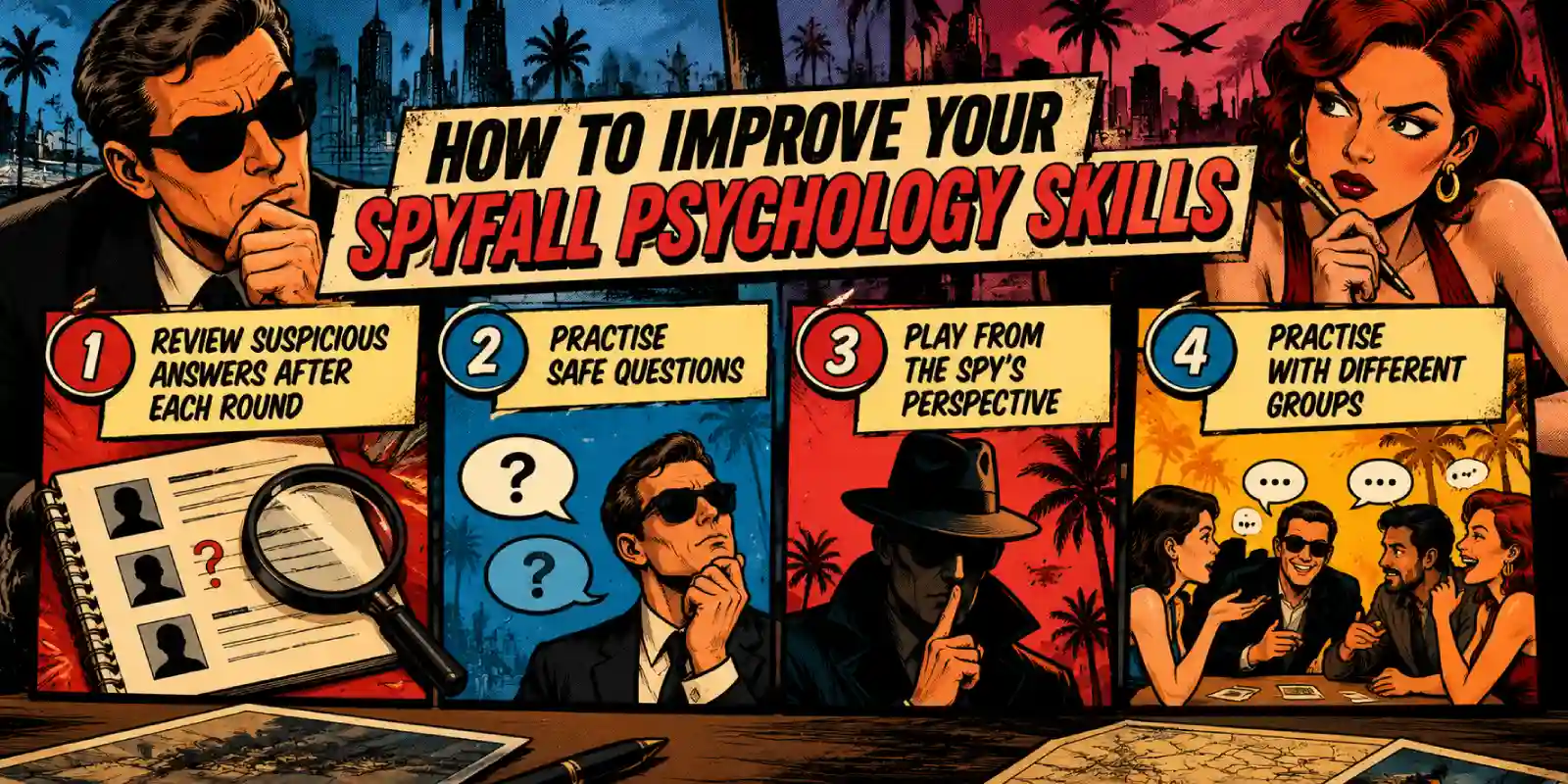
Becoming better at Spyfall does not require memorising every possible question. It comes from learning how to examine answers, control information and recognise your own assumptions.
A few simple exercises can make ordinary game nights surprisingly useful practice sessions.
Exercise 1: Review Suspicious Answers After Each Round
Once the spy has been revealed, discuss the answers that influenced the group’s decisions.
Ask which clues genuinely suggested missing knowledge and which were simply misunderstandings.
This is particularly helpful when the group accuses an innocent player. Those mistakes reveal which assumptions are causing problems.
Exercise 2: Practise Safe Questions
Choose a random Spyfall location and imagine you are an ordinary player. Write five questions that would be easy for somebody who knows the location but difficult for a spy to answer convincingly.
Then check whether any of those questions reveal too much.
For example, a question about clothing may be useful for a hospital, restaurant or beach. Naming a particular uniform or piece of equipment could make the location much easier to guess.
Exercise 3: Play From the Spy’s Perspective
Even when you are not the spy, consider what information the spy has received so far.
After each answer, ask yourself which locations now appear more likely.
This builds awareness of how innocent players can accidentally give away information. It also makes you better at identifying when another player is building their understanding from the same clues.
Exercise 4: Practise With Different Groups
Someone who dominates conversations in one group may barely speak in another. Different players also have different attitudes towards risk, humour and ambiguity.
Playing with a variety of people helps you avoid treating one conversational style as the correct way an innocent player should behave.
The more varied your experience, the easier it becomes to distinguish a tactical decision from a person’s ordinary habits.
Common Mistakes When Trying to Spot the Spy
Even experienced players sometimes lose because they become too focused on catching one person out. Spyfall rewards careful questioning, but overanalysing every word can be just as damaging as ignoring suspicious answers.
The following mistakes are especially worth avoiding.
- Accusing someone because they look nervous. Nervousness is common, especially among new players.
- Expecting detailed answers to every question. Ordinary players must protect the location as well.
- Treating one contradiction as conclusive proof. Misunderstandings happen, and assigned roles can affect answers.
- Asking questions that reveal the location. You may identify the spy while simultaneously giving them enough information to win.
- Ignoring quieter players. Speaking less does not automatically mean someone is innocent or suspicious.
- Assuming confident players are trustworthy. Delivery and genuine knowledge are different things.
- Following accusations without examining the evidence. Group agreement does not guarantee that the group is correct.
- Waiting too long to act. The spy may identify the location before the group reaches a decision.
A better approach is to maintain a short mental record of meaningful answers, compare players fairly and adjust your suspicion as new information becomes available.
Final Thoughts: Observation Beats Guesswork in Spyfall
Spyfall is often described as a game of bluffing, but its more interesting challenge is deciding what to believe. Everyone is withholding information, and some of the most suspicious answers can come from people who are playing perfectly honestly.
The strongest approach is to focus on knowledge rather than appearances. Notice contradictions, compare answers across different questions and resist the temptation to assume that nervousness or confidence reveals someone’s identity.
If you are an ordinary player, ask questions that test understanding without giving the location away. If you are the spy, listen for useful clues, participate naturally and avoid making claims that the available information cannot support.
Above all, remember that suspicion is a starting point for investigation, not proof. The next time someone gives an uncomfortable smile or pauses before answering, pay attention to what they actually say. That will usually tell you more about their Spyfall strategy than their expression ever could.
Frequently Asked Questions About Spyfall Psychology
How Can You Tell If Someone Is the Spy in Spyfall?
The most useful approach is to examine whether a player’s answers demonstrate genuine knowledge of the secret location. Look for repeated contradictions, irrelevant responses and excessive reliance on information that other players have already revealed.
No single behaviour proves someone is the spy. Stronger conclusions come from comparing several answers and considering reasonable innocent explanations.
What Are the Best Questions to Ask in Spyfall?
Good Spyfall questions test a characteristic of the location without naming it. Questions about typical visitors, time spent there, expected behaviour and the purpose of a visit can all work well.
For example, “Would you normally come here alone?” may tell informed players something meaningful while leaving the spy uncertain about the exact setting.
Does Avoiding Eye Contact Mean Someone Is Lying?
No. Avoiding eye contact is not a reliable indicator of deception, either in ordinary conversation or during Spyfall.
People may avoid eye contact because they are concentrating, uncomfortable, shy or naturally less inclined to maintain it. Their answers and decisions are generally more useful to examine.
Why Do Innocent Players Sometimes Act Suspiciously?
Ordinary players need to show that they know the location without helping the spy identify it. This can lead to vague answers, pauses and seemingly evasive behaviour.
Different assigned roles may also affect how players describe the same place. An unusual answer is therefore not necessarily an incorrect one.
What Is the Best Strategy When You Are the Spy?
Listen carefully, ask questions that separate possible locations and avoid making claims you cannot support.
Try to answer naturally without relying on constant generalities. When enough independent clues point towards one location, consider whether guessing is less risky than continuing to bluff.
Should You Accuse Someone Early in Spyfall?
An early accusation can work when a player has made a particularly revealing mistake. However, accusing someone based on weak evidence may end the round in the spy’s favour.
The timing also depends on the rules used by your group. In the original game, formal accusations require agreement from the other players, while some online versions handle voting differently.
Is It Better to Be Quiet or Talkative in Spyfall?
Neither approach guarantees success. Quiet players may avoid drawing attention, but they can also miss opportunities to demonstrate knowledge or influence the discussion.
Talkative players can collect useful information through questions, although they risk revealing too much or exposing inconsistencies. The best approach is to contribute when you have a useful question or answer.
Can Psychology Help You Win More Spyfall Games?
Psychological awareness can improve how you question other players and interpret their responses. It is especially useful for recognising confirmation bias, managing suspicion and avoiding assumptions based on body language.
It does not provide a guaranteed method for identifying the spy. Successful play also depends on the questions asked, the available locations, experience and a degree of luck.
Does the Same Strategy Work in Spyfall 2?
Many of the same principles apply, including controlling information, interpreting answers and avoiding weak accusations.
However, Spyfall 2 can include two spies, making the information problem more complicated. With two players potentially lacking knowledge of the location, suspicious answers may reflect different levels of information, and players need to account for the version’s specific rules.

Born and raised in London, Paul is the Digital Strategist and Content Manager. With a strong background in multilingual content creation, he works behind the scenes to ensure players worldwide have a seamless, engaging experience while hunting down spies. When he isn’t optimizing website content or testing new web features, you can usually find Paul training at his local MMA and boxing gym, or putting his own social deduction skills to the test in a fast-paced round of our social deduction game.