


Spyfall is one of those party games that can turn a simple question into a hilarious moment of suspicion. With secret identities, clever bluffing and unexpected answers, it is easy to see why people enjoy playing it with friends and family. But what if there are only two of you? Can you play Spyfall with two players and still have fun?
The good news is that you can! Although traditional Spyfall is designed for larger groups, there are ways to adapt the experience for just two people. Better still, Spyfall: Time Travel includes an official two-player variant. In this guide, we will explain how it works, share practical strategies and help you enjoy a fun game night without needing extra players.
Can You Play Spyfall with Just Two Players?
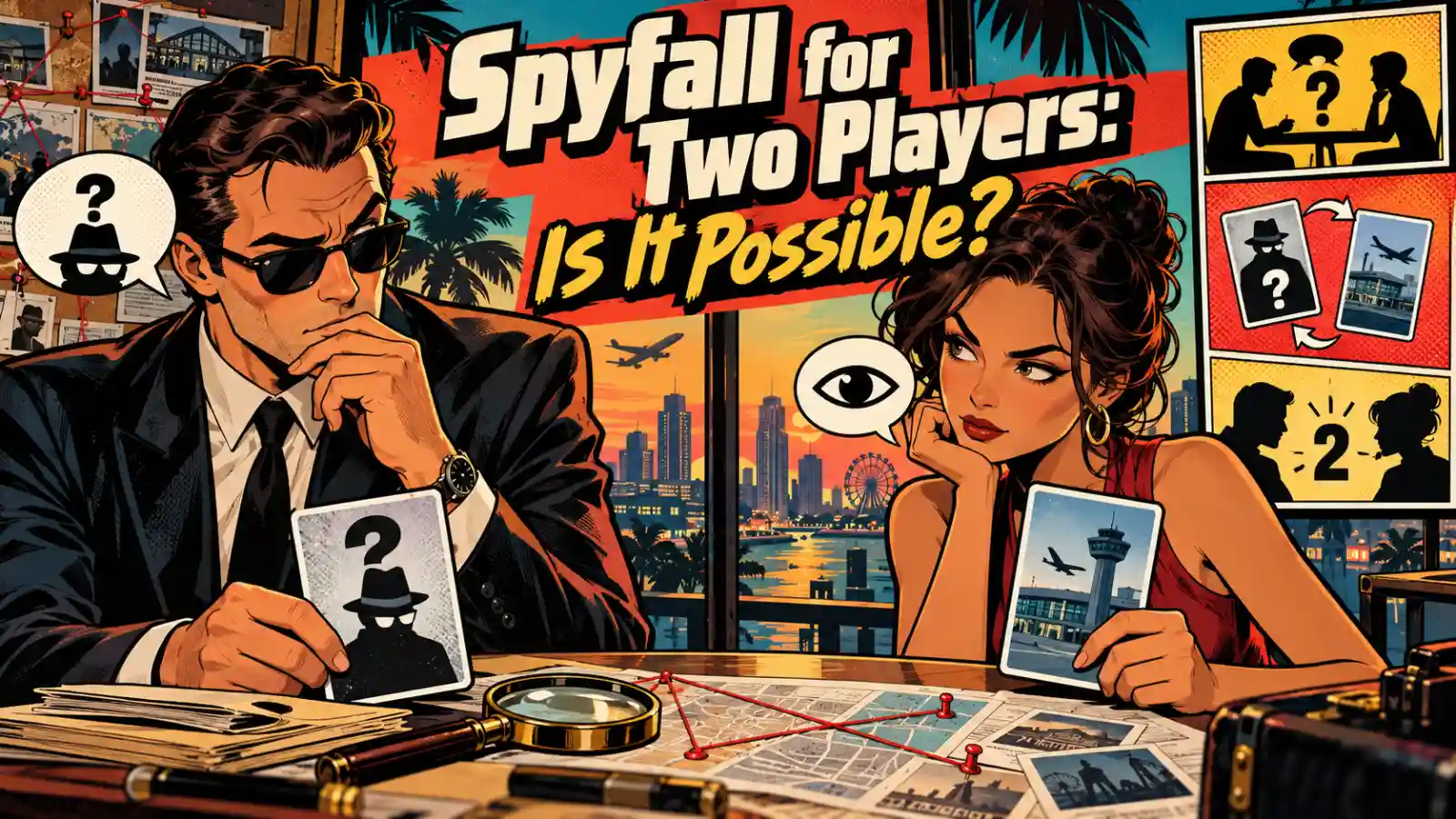
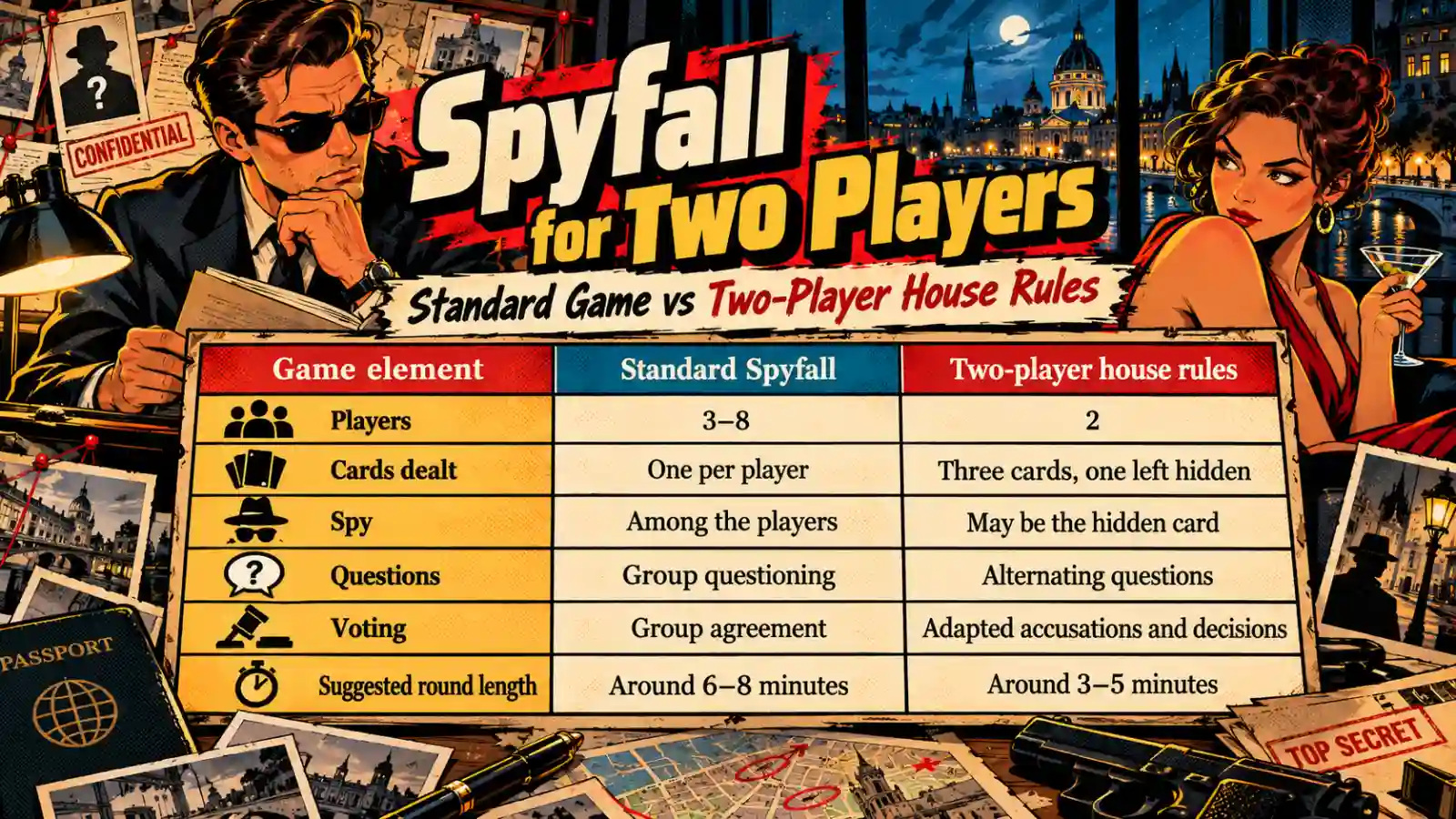
Yes, Spyfall can be played with two players, but the standard rules need adjusting. The original game is designed for 3–8 participants, where several people know a secret location and one hidden spy tries to discover it.
With only two participants, the mystery becomes much easier to solve. Fortunately, the official two-player variant in Spyfall: Time Travel introduces a hidden third card, which makes the game more unpredictable.
This simple adjustment helps preserve the excitement of bluffing, questioning and discovering secret identities.
How Does the Original Spyfall Game Work?
Before exploring the two-player version, it helps to understand what makes traditional Spyfall entertaining. The game combines social deduction, quick thinking and carefully chosen questions in a series of short rounds.
Basic Spyfall Rules and Objectives
At the beginning of each round, players secretly receive cards showing either a shared location or the role of the spy. Everyone except the spy knows where they are, and the group must identify the spy before they discover the location.
For example, the secret location might be a hospital, restaurant or railway station.
The Roles of the Spy and Other Players
The spy’s objective is to blend into the conversation while collecting enough clues to identify the location. Meanwhile, the other players must demonstrate their knowledge without accidentally revealing too much information.
The fun comes from finding the balance between giving useful answers and keeping important details secret.
How Questions, Accusations and Voting Work
Players ask each other questions about their surroundings, responsibilities or experiences at the mystery location. During the round, they can make accusations, while the spy can attempt to win by correctly guessing the location.
In standard Spyfall, accusations involve group agreement, making the voting process an important part of the game.
Why Is Traditional Spyfall Difficult with Two Players?
Playing Spyfall with only two people changes its basic dynamics quite dramatically. The usual system depends on uncertainty about which member of a group might secretly be the spy.
The Spy Becomes Too Easy to Identify
If one person receives the spy card and the other receives a location card, both can immediately work out their opponent’s identity. There is no mystery left to investigate, which removes much of the excitement.
Limited Bluffing and Deduction Opportunities
With several participants, players can compare different answers and observe suspicious behaviour. Two people have fewer clues available, so the game can quickly become a straightforward conversation rather than a challenging deduction experience.
Why Voting and Group Suspicion No Longer Work Properly
Traditional Spyfall relies on several people agreeing about who might be the spy. With two participants, meaningful majority decisions are impossible, so accusations and winning conditions need special adjustments.
Official Two-Player Rules in Spyfall: Time Travel
If you want to experience Spyfall as a pair, Spyfall: Time Travel offers a particularly interesting solution. Its official rules introduce a three-card system that keeps both players uncertain about whether the spy is actually sitting opposite them.
Setting Up the Three-Card System
The dealer selects three cards from one location deck: two location cards and one spy card. After shuffling them face down, each player receives one card, while the third remains hidden in the middle of the table.
How the Hidden Third Card Changes the Game
The extra card creates an important possibility: neither participant might be the spy. Instead, the spy card could be lying face down between them, meaning both players must consider whether their opponent is suspicious or completely innocent.
Asking Questions and Identifying the Spy
Players take turns asking questions while paying attention to each other’s answers. A participant might eventually accuse their opponent of being the spy or suggest that the hidden card contains the spy’s identity.
Winning Conditions in the Two-Player Variant
The official rules include several possible outcomes, depending on the players’ decisions. Accusing another player correctly can secure victory, while an incorrect accusation can cause both players to lose.
| Situation | Result |
|---|---|
| A non-spy correctly accuses the other player | The non-spy wins |
| A player accuses someone holding a location card | Both players lose |
| Both agree to reveal the middle card and it is the spy | Both players win |
| Both agree to reveal the middle card and it is a location | The spy wins |
The spy cannot accuse the opposing player of being the spy, although they can suggest revealing the middle card. Opening that card requires agreement from both participants, and the other standard rules continue to apply.
How to Play Classic Spyfall with Two Players: Alternative Rules
You do not necessarily need to purchase a different edition to enjoy the two-player concept. If you already own the original Spyfall, you can create a house-rule adaptation inspired by the official Time Travel variant using its existing cards.
Step 1 – Prepare the Location and Spy Cards
Choose a location deck and take two matching location cards alongside one spy card. Make sure both players understand that the secret spy card might remain unused during the round.
Step 2 – Deal the Cards Without Revealing Roles
Shuffle all three cards face down and give one to each player. Place the remaining card in the centre without looking at it, keeping the third identity completely secret.
Step 3 – Take Turns Asking Strategic Questions
Set a timer for around three to five minutes and begin questioning each other about the location. Keep questions indirect enough to avoid giving the spy an easy answer.
For example, try asking, “Would you normally expect this place to be busy in the morning?”
Step 4 – Make an Accusation or Guess the Location
At any point, a non-spy can accuse the other person or suggest checking the middle card. The spy can attempt to identify the secret location, so both participants must think carefully before making a final decision.
Step 5 – Keep Score and Start a New Round
For a simpler house-rule scoring system, award one point for a successful individual victory and one point each when both non-spies correctly reveal the hidden spy. Agree on your scoring rules beforehand and play several rounds with fresh locations.
Best Strategies for Winning Two-Player Spyfall
Even with modified rules, Spyfall can provide plenty of entertaining moments for two people. The secret is to focus on clever questions, subtle answers and careful observation rather than rushing towards accusations.
Ask Questions That Reveal Information Without Giving Away the Location
Try asking about everyday experiences rather than directly mentioning objects associated with the location. For example, “Would you enjoy spending an entire afternoon here?” might reveal useful information without exposing the answer.
Pay Attention to Vague or Unusual Answers
A spy may respond with general statements because they do not know the secret location. However, innocent players sometimes act deliberately mysterious, so one strange answer should never be considered definitive proof.
Use Bluffing and Misdirection Carefully
If you are the spy, give believable responses without making unnecessary assumptions about your surroundings. If you know the location, answer naturally while avoiding details that could immediately reveal it.
Keep Rounds Short to Maintain Suspense
Long questioning sessions can make a two-person game feel repetitive. Try shorter rounds initially, then adjust the timer according to how challenging and entertaining you find the experience.
Best Questions to Ask in Two-Player Spyfall
Good questions are the heart of Spyfall, especially when there are only two participants. The best ones reveal how familiar someone is with a location without immediately identifying it.
General Questions That Work at Most Locations
Start with questions about atmosphere, routines and ordinary experiences. Asking whether a location is usually crowded or whether people visit regularly can work across several different settings.
Clever Questions to Catch the Spy
More specific questions can test whether your opponent understands the environment. For example, asking whether someone would need special clothing might produce an interesting answer at a hospital, swimming pool or construction site.
Questions to Avoid When Playing with Two People
Avoid questions that practically reveal the location themselves. Asking “Which platform does our train leave from?” makes guessing a railway station far too easy for the spy.
Here are some useful examples to try:
| Question | Purpose | Risk |
|---|---|---|
| Is this place usually noisy? | Explore the atmosphere | Low |
| Would you bring a friend here? | Understand its purpose | Low |
| Do people usually wear uniforms? | Explore typical activities | Medium |
| Would you expect to pay for entry? | Narrow down possibilities | Medium |
| What equipment would you need here? | Test specific knowledge | High |
Can You Play Spyfall Online with Two Players?
Online Spyfall games offer a convenient way to enjoy social deduction without physical cards. However, not every website supports two-person sessions, so it is important to check the available settings before starting.
Online Spyfall Player Limits
Many browser-based versions follow the traditional multiplayer format and require at least three participants. Some platforms offer different player limits or custom settings, so support for a two-player game varies.
Using Video Calls or Private Rooms for Modified Games
If you and your friend live in different places, you can organise a modified game over Zoom, Discord or another video-calling service. Use a private card-dealing tool that can preserve the hidden third card, then ask your questions aloud.
Playing with a Virtual Third Participant
A virtual participant can theoretically add uncertainty, but only if a properly designed bot can handle secret roles and answer questions. Simply adding an inactive third account will not reproduce the experience of a genuine additional player.
Advantages and Disadvantages of Playing Spyfall with Two People
Two-player Spyfall offers a different experience from the lively group version. Understanding its strengths and weaknesses can help you decide whether it suits your next game night.
| Advantages | Disadvantages |
|---|---|
| Easy to organise without a group | Less social interaction |
| Quick setup and shorter rounds | Fewer opportunities for complex deduction |
| Suitable for couples and friends | Modified rules are necessary |
| Great for practising clever questions | Some rounds may feel predictable |
| Flexible for playing at home | Less variety in player behaviour |
For casual entertainment, the advantages can easily outweigh the limitations, particularly if both players enjoy experimenting with their strategies.
Best Alternatives to Spyfall for Two Players
Sometimes you might prefer a game specifically designed for two people rather than adapting a larger party game. Fortunately, several excellent alternatives offer similar opportunities for deduction, clever thinking and exciting decisions.
Mr Jack Pocket – Hidden Identity and Deduction
Mr Jack Pocket is a compact deduction game set in London, where one player tries to expose a hidden criminal while the other attempts to escape detection. It provides a competitive experience with a stronger emphasis on strategy.
Codenames: Duet – Cooperative Word-Based Deduction
Codenames: Duet challenges two players to work together using carefully chosen word clues. Unlike Spyfall, it focuses on cooperation rather than identifying a dishonest opponent, making it ideal for partners who enjoy teamwork.
Guess Who? – Two-Player Questioning and Elimination
Guess Who? offers a lighter deduction experience in which players ask yes-or-no questions to identify a hidden character. Its straightforward gameplay makes it accessible to families and people unfamiliar with more complicated deduction games.
| Game | Players | Main experience |
|---|---|---|
| Spyfall (adapted) | 2 | Bluffing and hidden identities |
| Mr Jack Pocket | 2 | Competitive deduction |
| Codenames: Duet | 2+ | Cooperative word clues |
| Guess Who? | 2 | Questioning and elimination |
Is Spyfall Worth Playing with Only Two People?
Yes, Spyfall can absolutely be worth playing with two people, especially if you enjoy clever conversations, light-hearted competition and unexpected twists. Although the traditional game works better with a group, the hidden third-card system creates enough uncertainty to make a two-person session entertaining.
For the most authentic experience, consider using the official rules from Spyfall: Time Travel. Alternatively, adapting your existing Spyfall deck is an easy way to enjoy a relaxed evening with a friend or partner.
The most important thing is to approach the game with a little creativity. Experiment with different questions, keep your rounds lively and enjoy the challenge of discovering whether your opponent is telling the truth.
Frequently Asked Questions About Two-Player Spyfall
If you are still unsure how to organise a two-player game, these quick answers cover the most common questions. They should help you choose the right version and begin playing with confidence.
What Is the Minimum Number of Players for Spyfall?
The original Spyfall is designed for a minimum of three players and supports up to eight. However, modified rules allow two participants to enjoy a similar experience.
Is There an Official Two-Player Version of Spyfall?
Yes, Spyfall: Time Travel includes official rules for two players. These introduce a hidden third card to preserve uncertainty about the spy’s identity.
Can You Play Spyfall with Two Players Without Changing the Rules?
No, the original rules do not work properly with only two participants because the spy becomes immediately identifiable. Adjusting the card distribution and accusation rules solves this problem.
Can Two People Play Spyfall Online for Free?
Potentially, yes, if a free online version supports custom two-player rules or suitable private card distribution. Check the platform’s player limits before starting.
How Long Should a Two-Player Spyfall Round Last?
Around three to five minutes is a sensible starting point for an adapted game. You can shorten or extend the timer depending on your preferences and experience.
Is Spyfall Suitable for Couples?
Absolutely! Modified two-player Spyfall can be a fun activity for couples who enjoy playful competition, interesting questions and trying to outsmart each other.
Can You Play Spyfall with Three Players Instead?
Yes, the classic Spyfall game supports three participants, and Spyfall: Time Travel also includes a special three-player variant. Adding a third person can provide more interesting questioning and additional uncertainty.
Ready to test your detective skills? Grab your Spyfall cards, invite a friend and try the two-player variation. You might discover that even a small game can lead to some brilliantly suspicious conversations!

Nacido y criado en Londres, Paul es el estratega digital y gestor de contenidos detrás de Spyfall. Con una sólida experiencia en la creación de contenidos multilingües, trabaja entre bastidores para asegurar que los jugadores de todo el mundo tengan una experiencia fluida y atractiva mientras cazan espías. Cuando no está optimizando el contenido del sitio web o probando nuevas funciones, normalmente puedes encontrar a Paul entrenando en su gimnasio local de MMA y boxeo, o poniendo a prueba sus propias habilidades de deducción social en una partida rápida de Spyfall.