


Picture the scene. You are on a Submarine, a friend leans forward and asks, “Can you get some fresh air here?”, and suddenly every pair of eyes at the table is on you. Say too much and the spy works out where you are. Say too little and your mates start wondering whether you are the spy. 🤫
Clever questions get most of the glory in this game, but in our experience the answers are where rounds are really won or lost. This guide is all about giving Spyfall answers that your friends trust and the spy can’t use. We will walk you through a simple test you can run in your head, real examples by location, six practical techniques, how to deal with awkward questions and what changes as the clock runs down.
Why Answering Is the Hardest Job in Spyfall
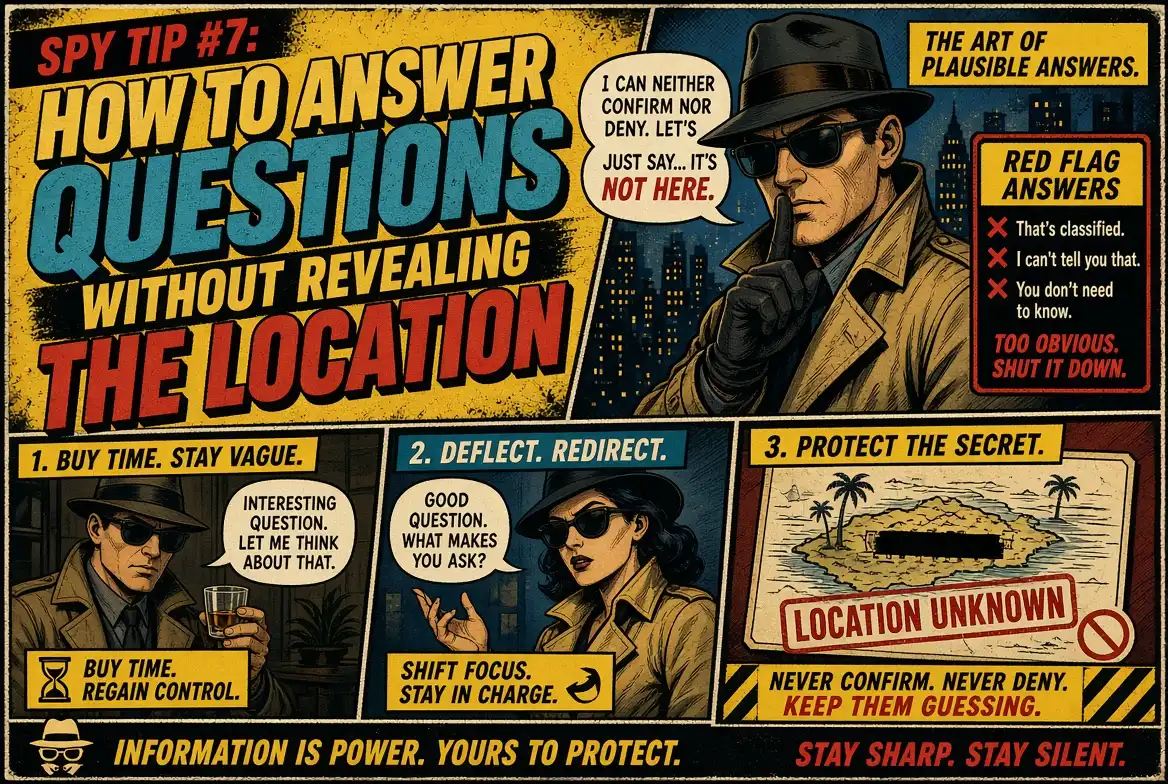
Every answer you give has two audiences at once. Your fellow non-spies need proof that you know where you are, while the spy listens for the one detail that gives it away. Getting that balance right, under pressure and in a few seconds, is what makes Spyfall so tense.
There is no wriggling out of it either. Under our Spyfall game rules, the player who is questioned must answer, and no follow-up questions are allowed, so each reply has to stand on its own. Get it wrong in either direction and the spy benefits: they score four points for a correct location guess and four more if the group wrongly indicts an innocent player.
One player on Reddit’s r/boardgames summed up the whole challenge neatly:
“the job of the non spy is to communicate that you know where you are without actually giving away where you are.”
The Golden Rule: Specific Enough to Trust, Vague Enough to Hide
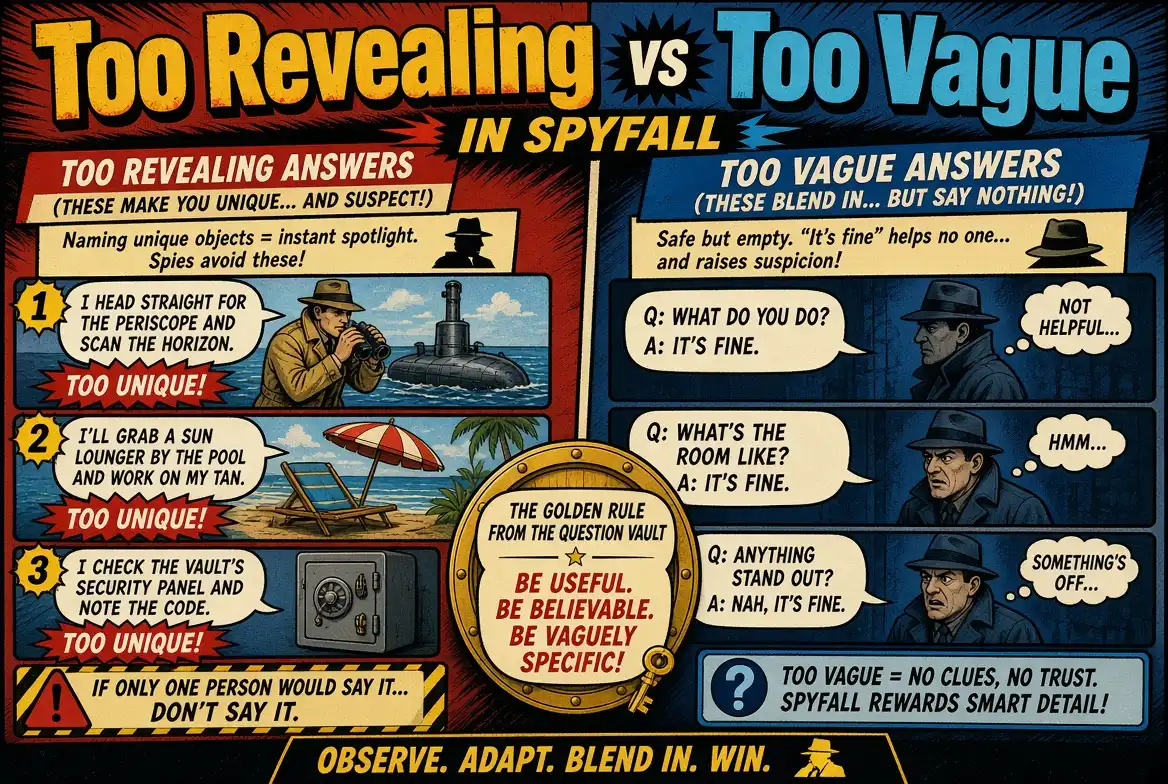
Good answers live in a sweet spot between detail and mystery. If you stay too general, you sound like someone bluffing, and if you go too specific, you hand the spy a free win. The best Spyfall answers feel personal and confident while still fitting more than one place on the list.
The Three-Location Test
This is the habit we teach every new player at our table. Before you speak, ask yourself one quick question: could this answer fit at least three locations, including mine? It takes a second or two once you are used to it, and it saves countless rounds.
- Picture your own location and the people in it.
- Think of two similar locations from the list, such as Space Station and Polar Station if you are on a Submarine.
- Choose a detail that is true of all three but still sounds like your own experience.
Non-spies can glance at the location list as well, and doing so makes this test far easier. Nobody will think twice about it, because everyone at the table has the same list in front of them.
Spyfall Answers in Action: Examples from Real Locations
Theory only goes so far, so here is how the test works with real locations from the original Spyfall deck. For each question we show an answer that gives too much away, one that says too little and one that hits the mark. The last column shows which other locations the good answer also fits.
| Location | Question | Too revealing | Too vague | Just right | Also fits |
|---|---|---|---|---|---|
| Submarine | “Can you get some fresh air here?” | “Not until we surface.” | “Not really.” | “Not easily, and you notice it after a few hours.” | Space Station, Polar Station |
| Beach | “What are you wearing today?” | “Swimming trunks and flip-flops.” | “Normal clothes.” | “As little as I can get away with. It’s warm.” | Day Spa |
| Hospital | “Why are you here?” | “Waiting for my X-ray results.” | “Just because.” | “Honestly, I’d rather be anywhere else today.” | Police Station, Embassy |
| Polar Station | “What’s the hardest part of being here?” | “The ice and the freezing wind.” | “Nothing much.” | “Being so far from home for so long.” | Ocean Liner, Military Base |
| Passenger Train | “How long are you staying?” | “Until the last stop.” | “A while.” | “A few hours, then I’m off somewhere else.” | Airplane, Hotel |
Notice the pattern in the right-hand answers. They describe a feeling or an experience rather than an object, which is exactly what a spy struggles to decode. They also sound natural, so nobody at the table feels the need to question them twice.
Six Techniques for Location-Safe Answers
The table shows the idea, but you need a toolkit to use it on the fly. These six techniques are the ones we lean on most, and they work at almost any location in the deck. Mix and match them, and your Spyfall answers will quickly become harder to read.
Talk About Feelings, Not Features
Moods are your safest ground. Saying you feel cramped, bored, excited or slightly nervous tells your friends you are picturing a real place. The spy, meanwhile, has to guess which of a dozen locations could make someone feel that way.
Lean on Your Role, Carefully
If your card shows a role, it can be a gift, because answering in character sounds natural. The trick is to use traits of that role that exist in plenty of places. A manager, a security guard or a cook could turn up in many locations, so talk about long shifts or difficult customers rather than your exact duties.
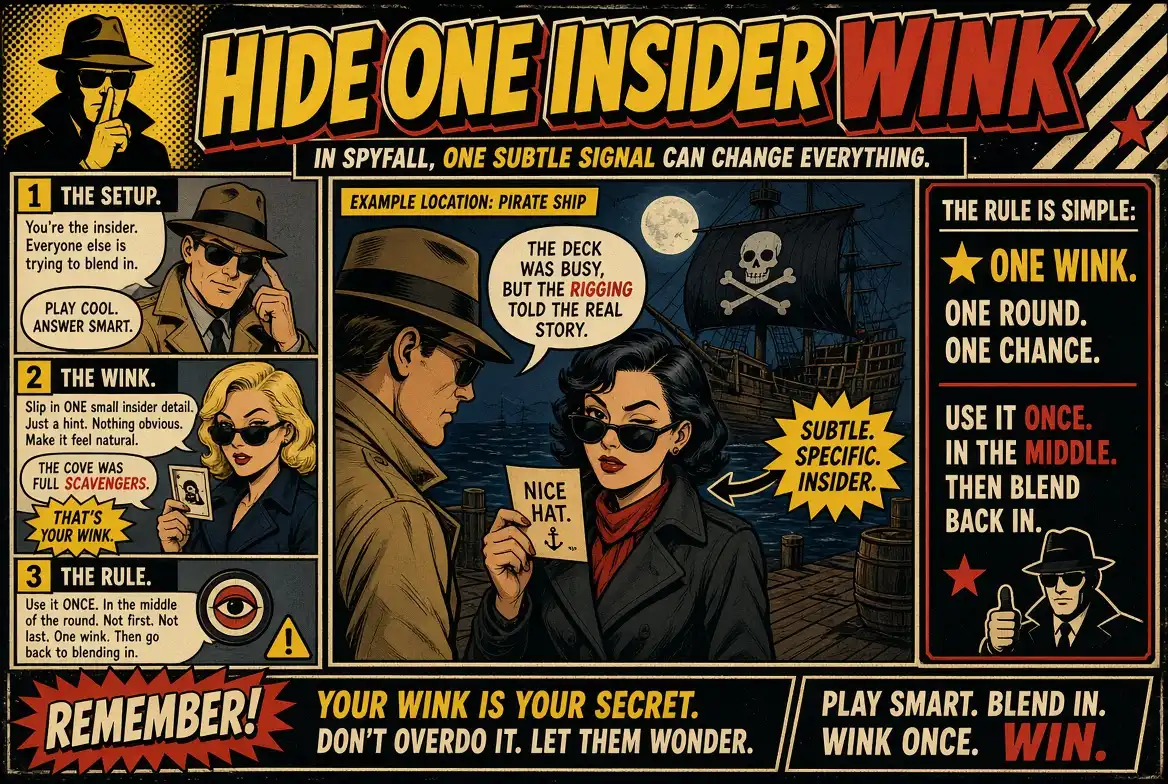
Choose Shared-Trait Details
Some details belong to whole groups of locations. Uniforms point to the Hospital, the Military Base and the Police Station alike. Queues fit the Bank, the Supermarket and the Embassy, while background noise suits the School, the Circus Tent and the Restaurant.
Answer the Question Behind the Question
Most questions are really testing one thing: how busy, how dangerous, how expensive or how comfortable a place is. Work out what the asker is fishing for and answer that, rather than the literal detail. If someone asks what you can hear, they usually want to know how crowded it is, so “it’s never truly quiet” does the job.
Keep It Short
One sentence and one detail is plenty. Long explanations leak information and, ironically, make you sound like a spy trying too hard. If you catch yourself adding “because”, stop talking and pass the question on.
How to Handle Tricky Questions
Some questions are designed to make answering awkward, whether the asker means it or not. Knowing how to deal with them stops you panicking and handing over the location by accident. These are the four situations we see most often.
Yes-or-No Questions
A bare “yes” or “no” gives the spy a free filter and can sound evasive. Add a small qualifier that keeps things open, such as “Yes, though it depends on the day.” It sounds thoughtful and protects the location at the same time.
Questions That Push for Too Much Detail
Sometimes a friend asks something that is almost impossible to answer safely, like what the most expensive thing in the room is. You must still answer, but you can stay general, and saying “I can’t answer that without giving it away” works well once per round. Because follow-up questions aren’t allowed, the asker can’t immediately press you, and the turn moves on.
Trap Questions
Experienced players love questions that only make sense in some places, like asking where to go for a walk when everyone is on a Space Station. As a non-spy, you simply answer in a way that fits the real setting, and the trap catches the spy instead. If you want to get better at setting these yourself, our guide on how to spot the spy covers the tells to watch for.
When You’ve Been Too Vague and Eyes Turn to You
Everyone fluffs an answer now and then. Don’t over-explain or get defensive, because both look suspicious. On your next turn, give one confident and slightly more specific detail, and remember that a vote needs to be unanimous, so one doubtful friend can’t sink you alone.
Early-Round vs Late-Round Answers
Your answers should change as the clock ticks down. A round on our site usually lasts six to ten minutes, as explained in our guide to how long a round of Spyfall lasts, and the spy gathers clues the whole time. Think of the round in three stages:
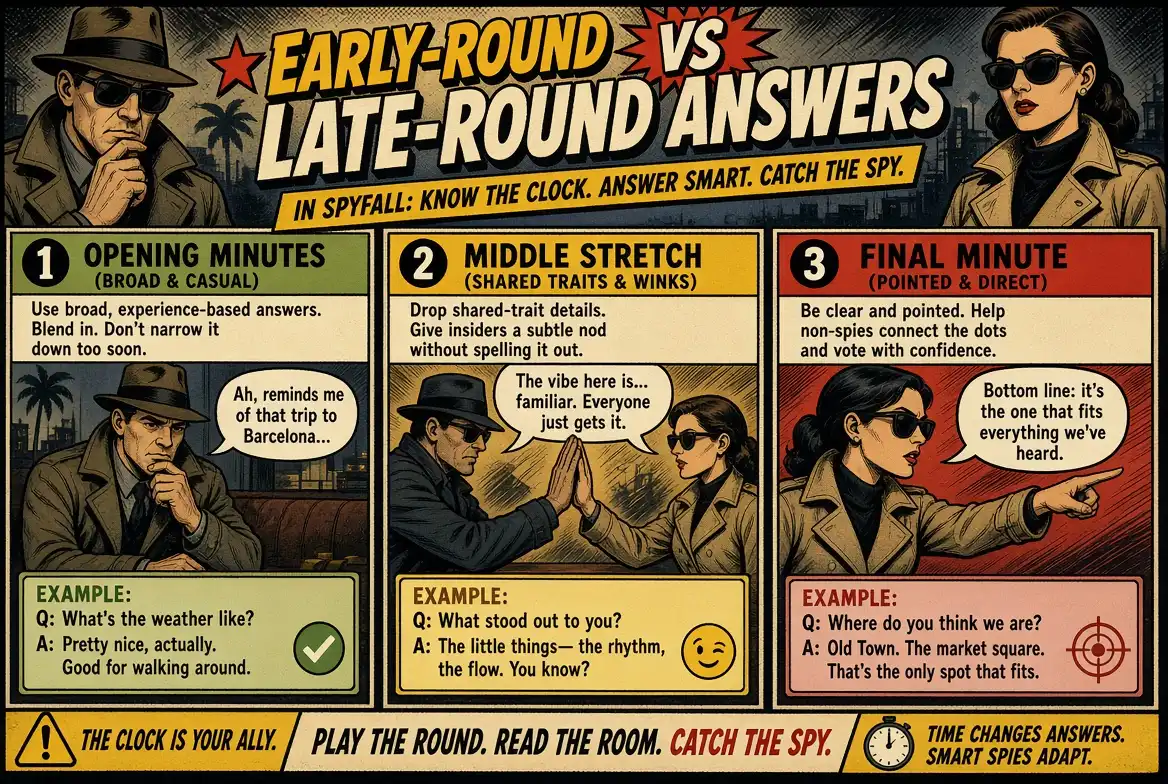
Word Impostor gives sound advice for those closing moments:
“Save the one unmistakable object or landmark unless you’re ready to push for a vote.” (Word Impostor)
Bear in mind that the spy can stop the round and guess the location at any moment. So never assume you have time to repair a giveaway, because sharp Spyfall answers in the opening minutes are what keep the spy guessing.
What If You’re the Spy?
Sooner or later you will draw the spy card, and the job turns upside down. Now you are the one answering without knowing the location, and every reply is a careful bluff. Hobby World describes the challenge in its official game description:
“The spy doesn’t know which location he is at, so he has to listen carefully. When it is his time to answer — he’d better create a good story!” (Hobby World)
The safest approach is to match the tone and detail level of the answers you have already heard, then add one detail loose enough to fit several places. Our guide on how to win Spyfall covers spy tactics in much more depth.
Common Answering Mistakes to Avoid
Even experienced players slip into bad habits when the pressure is on. Most weak Spyfall answers fall into one of a handful of traps. Keep this checklist in mind, and you will avoid the classic errors.
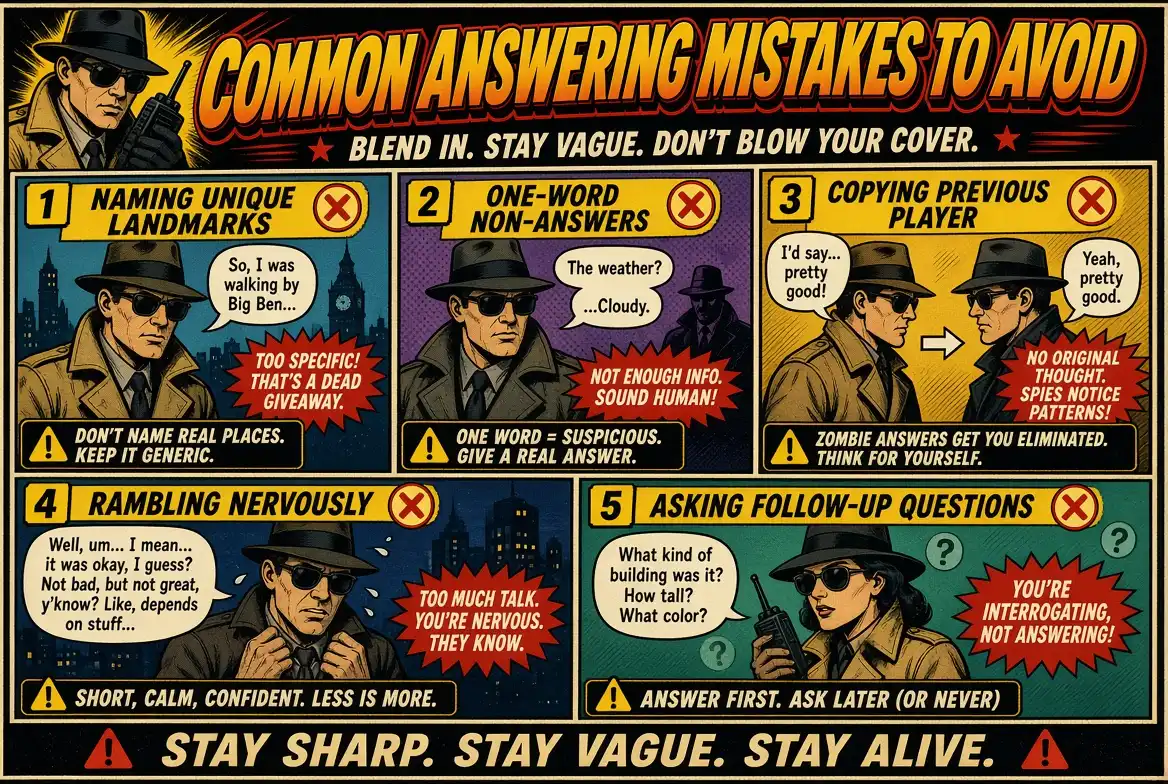
If you are introducing new players, it helps to cover these habits from the start. Our guide on explaining Spyfall to new players shows how to teach the game in a few minutes.
Practise Your Answers in a Free Online Game
Reading tips is one thing, but answering under pressure is a skill you build by playing. A few quick rounds will teach you more than any guide. The good news is that you can start a free game right now, with every player using their own phone, tablet or laptop.
Pair this guide with our list of the best Spyfall questions, so both sides of the conversation improve together. Within an evening, you will notice the whole table getting craftier. 🎲
Final Thoughts
The best answers feel like a wink to your friends and a shrug to the spy. Run the Three-Location Test, talk about feelings rather than features and keep it short. Master that, and you will win far more rounds, whichever card you draw.
Frequently Asked Questions
These are the questions we hear most often about answering in Spyfall. We have kept the answers short and in line with our official rules.
What should I say if I’m not the spy?
Say something personal and true to your location that would also fit two or three other places. Feelings and experiences work far better than objects.
How vague should my answers be?
Stay vague about objects but specific about feelings and experiences. One real detail is always better than a non-answer that makes you look suspicious.
Can you refuse to answer a question?
No, under our rules the player who is asked must answer. You can, however, keep your reply general if the question pushes for too much detail.
Can players ask follow-up questions?
Not under our rules. Once you answer, it is your turn to ask someone else, and you can’t immediately question the person who just asked you.
What happens if someone accidentally gives the location away?
The spy is allowed to end the round and guess right away, so act quickly. If the round runs out with no successful vote, see what happens if nobody guesses the spy.
How does the spy answer without knowing the location?
The spy listens closely, mirrors the tone of earlier replies and keeps their Spyfall answers safely general. They then add one detail that could fit several locations.

Born and raised in London, Paul is the Digital Strategist and Content Manager. With a strong background in multilingual content creation, he works behind the scenes to ensure players worldwide have a seamless, engaging experience while hunting down spies. When he isn’t optimizing website content or testing new web features, you can usually find Paul training at his local MMA and boxing gym, or putting his own social deduction skills to the test in a fast-paced round of our social deduction game.