


Look at most games shelves in a UK living room and you will spot the same two boxes sitting side by side. Both have secret agents on the cover, both promise a brilliant evening, and both get pulled out when friends come round. So when a group can’t decide, the Spyfall vs Codenames question pops up fast, and plenty of people assume the two games are much the same. 🕵️
They really aren’t. Spyfall hides one spy among the players, and everyone else tries to unmask them through sneaky questions about a secret location. Codenames splits the table into two teams racing to decode one-word clues on a grid of 25 words. We have played both more times than we can count, so here is an honest look at how each one plays, who it suits and when to reach for it.
The Quick Verdict
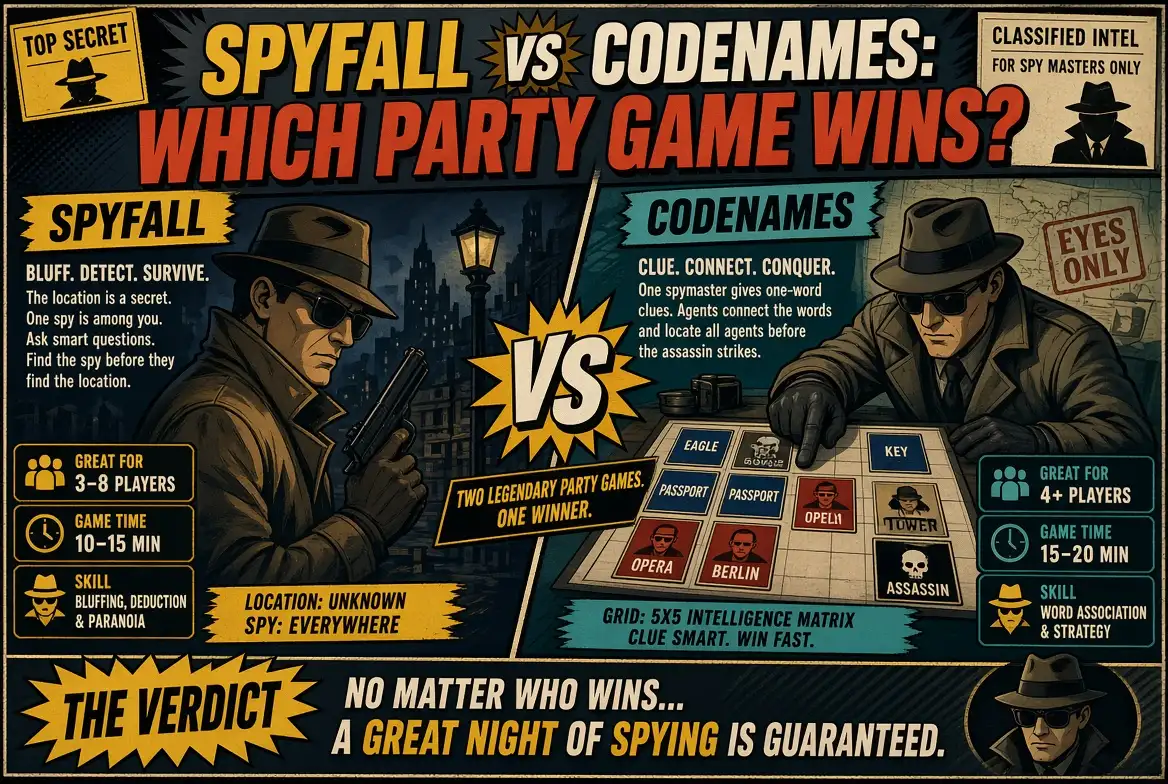
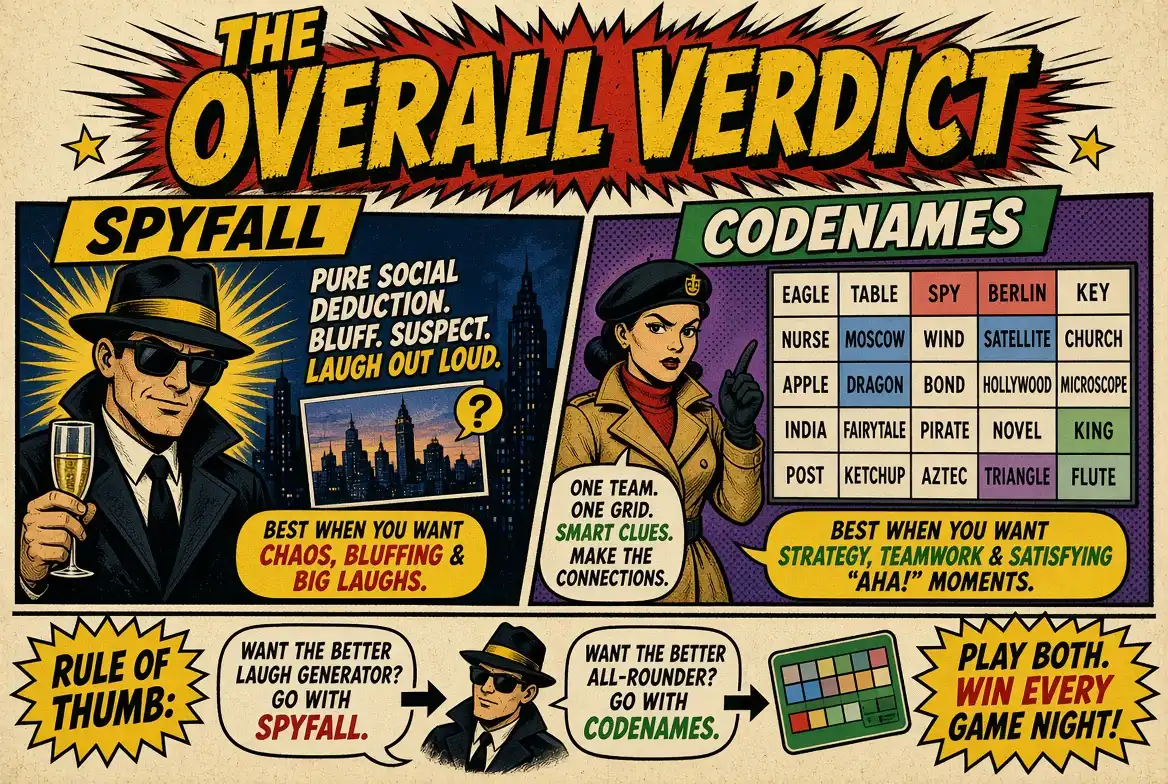
If you want the short version, here it is. Codenames is the safer all-rounder for mixed groups, while Spyfall delivers bigger laughs with friends who love to talk. Neither is a bad buy, and lots of groups end up owning both.
- Pick Spyfall for four to eight chatty players who enjoy improvising and a little acting.
- Pick Codenames for groups who love wordplay, team rivalry and a bit of quiet thinking.
- Only two of you? Try Codenames Duet or our two-player Spyfall variant.
Same Spy Theme, Completely Different Games
It’s easy to see why people lump these two together. Both arrived in the mid-2010s, both lean on espionage, and both turn up on every “best party games” list going. Yet comparing Spyfall vs Codenames is a bit like comparing charades with a crossword: they share a theme but almost nothing else.
Spyfall is a hidden-role social deduction game, built around one liar and a room full of suspicion. Codenames is a team word association game, and there is no hidden traitor at all. Once you understand that split, choosing between them becomes much easier.
What Is Spyfall?
Spyfall is the game this site is built around, so we will keep the basics brief. One player is the spy, everyone else shares a secret, and the clock is ticking. The fun comes from questions that are clever enough to catch the spy without giving the game away.
How a Round Plays Out
Every player except one sees the same secret location, such as a submarine, a school or a supermarket. The spy sees only the word “Spy” and must work out where they are from the conversation. Players take turns asking each other questions, and anyone can call a vote that, on our online version, has to be unanimous.
The spy can stop the round at any moment and guess the location. Rounds are short, lasting 6–10 minutes under our online rules and eight minutes in the original box. If you want the finer details, our page explaining how Spyfall works, step by step covers scoring and voting.
Spyfall in a Nutshell
Spyfall was designed by Alexandr Ushan and published by Hobby World in 2014. The original box plays three to eight people, while Spyfall 2 stretches the count to 12. We have already looked at how Spyfall stacks up against Werewolf, so here we will focus on what makes it different from a word game. Ars Technica put its finger on the key point in a 2016 review:
“Spyfall hinges pretty largely on the group of people you play it with.” (Ars Technica)
What Is Codenames?
Codenames is a word game dressed up as a spy thriller. Instead of hunting a traitor, you are trying to read your teammate’s mind through a single, carefully chosen word. It’s simple to teach, yet every clue can spark a surprisingly heated debate.
How a Game of Codenames Works
Twenty-five word cards are laid out in a five-by-five grid. Each team has a spymaster who secretly knows which words belong to their side, which are neutral and which one is the deadly assassin. Turns follow a simple pattern:
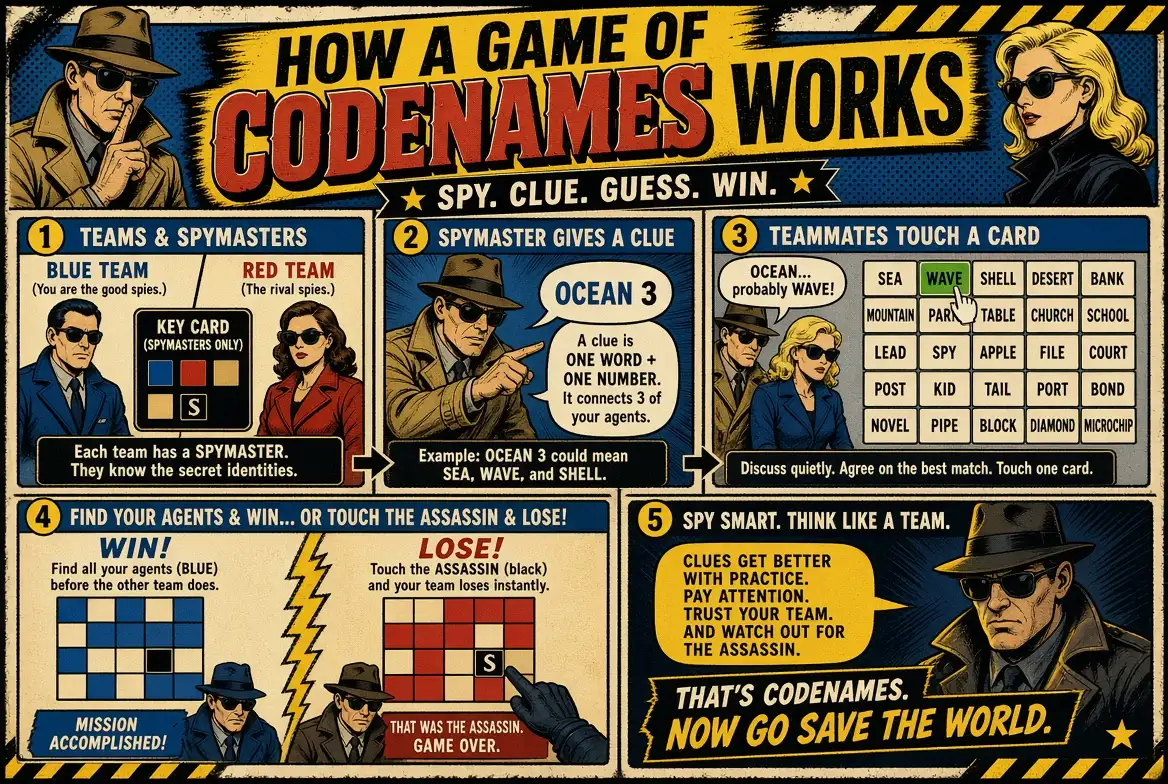 Notice what is missing: nobody lies. The tension comes from ambiguity, nervous guesses and a spymaster trying very hard to keep a straight face.
Where Codenames Came From
Codenames was designed by Vlaada Chvátil and published by Czech Games Edition in 2015. It went on to win the 2016 Spiel des Jahres, Germany’s most famous Game of the Year award, along with several Origins Awards. Its publisher sums up the whole idea in one line:
“Give your team clever one-word clues to help them spot their agents in the field.” (Czech Games Edition)
The family has grown since then. Codenames Pictures (2016) swaps words for illustrations, and Codenames Duet (2017) turns the game into a cooperative challenge for two.
Spyfall vs Codenames: Head-to-Head Comparison
A table won’t capture the atmosphere, but it does clear up the practical questions quickly. Here is how the two games compare on the details that matter when you are planning a night in. Figures come from the publishers and the official rules.
| Spyfall | Codenames | |
|---|---|---|
| Type | Hidden-role social deduction | Team word association |
| Players | 3–8 in the box (Spyfall 2: up to 12) | Officially 2–8+, best with 4+ |
| Length | 6–10 minutes per round | Around 15 minutes per game |
| Teams | No, the spy against everyone | Yes, two rival teams |
| Lying | The spy bluffs | None, clues must be honest |
| Key skill | Quick questions and reading people | Vocabulary and lateral thinking |
| Downtime | Very little | Spymasters wait while teams debate |
| Two players | Special two-player variant | Codenames Duet |
| Free online | spyfall.live | codenames.game |
In short, Spyfall is faster and more social, while Codenames is more structured and puzzle-like. Which matters more depends entirely on the people around your table.
How Each Game Feels at the Table
Rules only tell you half the Spyfall vs Codenames story. The real difference shows up in the noise level, the pace and who ends up enjoying themselves most. These four contrasts are what we notice every time we play both on the same evening.
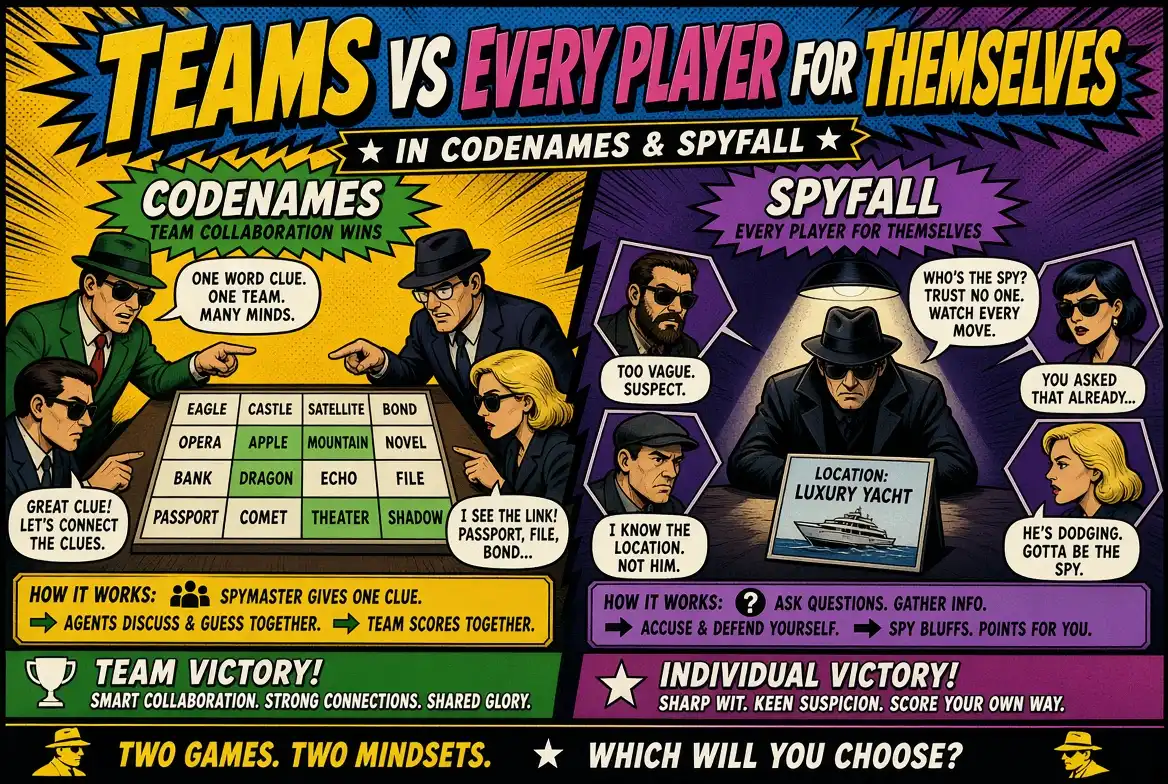
Bluffing vs Clue-Giving: Two Kinds of Clever
Spyfall rewards quick thinking under suspicion. You have a few seconds to answer “How often do you come here?” in a way that sounds natural, while the spy is desperately fishing for clues. Our list of the best Spyfall questions shows how much craft goes into a good one.
Codenames is a calmer kind of clever. The challenge is finding one word that links “PIANO”, “TRUNK” and “KEY” without dragging your team towards the assassin. It feels more like a shared puzzle than an interrogation. 🧠
The Spymaster’s Poker Face and Other Downtime
Codenames has one notable quirk: the spymasters spend much of the game silent. They watch their team misread a perfect clue and must not react, which some people love and others find agonising. Guessers on the other team also wait while their rivals argue.
Spyfall barely has downtime at all. Questions bounce round the table every few seconds, so nobody has time to check their phone.
Talkers vs Wordsmiths: Which Group Are You?
This is the most useful question to ask before you choose. Spyfall needs people who are happy to speak up, improvise and act a little, which is why that Ars Technica line rings so true. A shy group can make it fall flat.
Codenames suits people who enjoy words, and it is gentler on nervous players. Its weak spot is a group with very different vocabularies, where a clue that seems obvious to one person means nothing to another.
Pros and Cons at a Glance
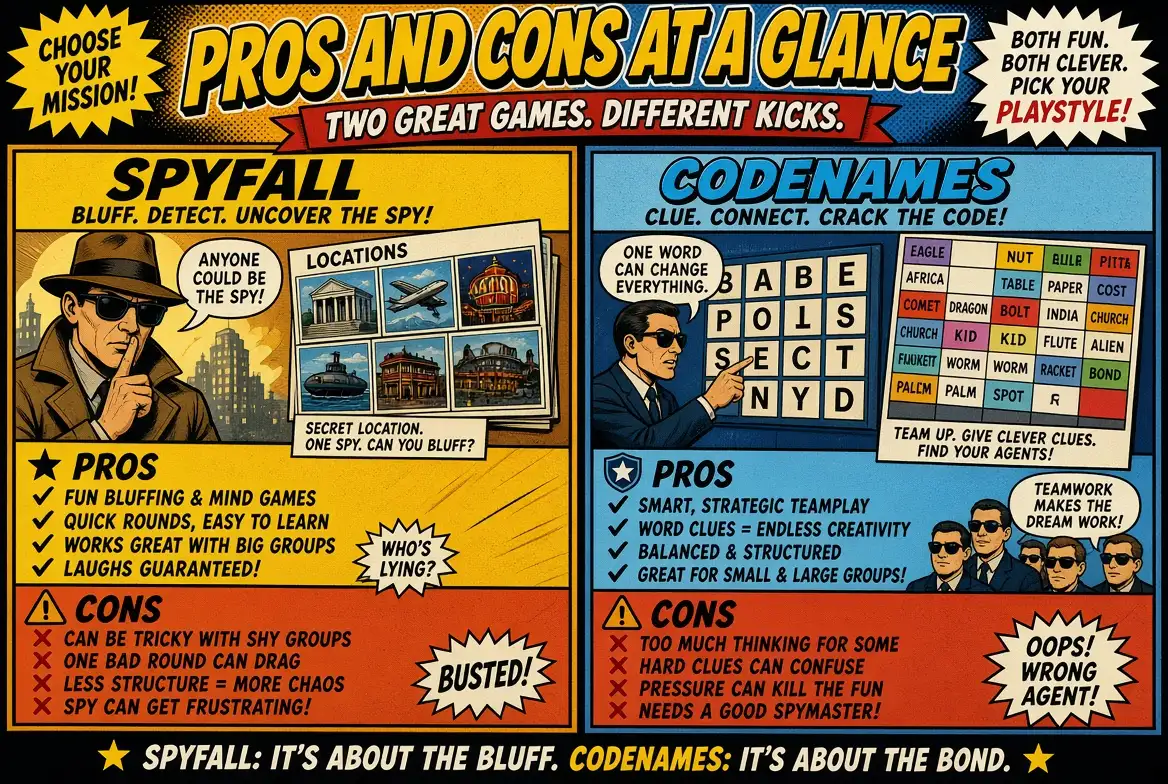
Need the highlights in one place? This summary covers the main strengths and weaknesses of each game. Use it as a quick sense check before you set anything up.
Which Should You Play? Verdict by Situation
The right answer changes with the night you are planning. Below, we pair the most common situations with the game we would pick. Find the one that sounds like your group.
Just the Two of You
Codenames Duet is the clear winner for couples and pairs. Designed by Vlaada Chvátil and Scot Eaton, it turns the game into a cooperative mission where you both give and receive clues. Spyfall needs a variant with just two, and our guide to Spyfall for two players explains how it works.
Four to Eight Friends
Both games shine at this size, so think about personalities. A lively, teasing group will love Spyfall, while a competitive, wordy group will gravitate towards Codenames. If you go with Spyfall, brush up on how to spot the spy before your first round.
Big Groups and Office Socials
Codenames handles a crowd better because teams can simply grow. Its official online version even allows up to 64 players in one room. Spyfall starts to slow once you pass nine players, and Spyfall 2 tops out at 12.
Family Night and Younger Players
Codenames carries a 10+ rating from its publisher, and Codenames Pictures is a handy option for children who prefer images to words. Spyfall works well with teenagers and avoids arguments about picking teams. Our article on whether Spyfall is good for family game night goes into more detail.
Playing Online: Getting Started in Minutes
Both games have free browser versions, which is handy for remote friends. Codenames Online at codenames.game is the publisher’s official version, needs no account and includes Duet. Spyfall runs free right here, and getting started takes four steps:
- Start a free game of Spyfall on our homepage.
- Choose your game settings.
- Send the room code to everyone playing.
- Everyone reads their own screen, and the questions begin.
Once you have played a few rounds, our guide on how to win Spyfall will sharpen your game as both spy and detective.
Can You Play Both in One Night?
Absolutely, and it’s often the best way to keep everyone happy. Start with Codenames while guests are still arriving, because teams can easily absorb latecomers. Once everyone is settled and warmed up, switch to a few rounds of Spyfall for the big laughs.
Final Thoughts
There is no wrong answer here, only the right game for the people in front of you. Settle the Spyfall vs Codenames debate by looking at your guest list: wordsmiths will love the grid, and natural performers will love the spy. If you fancy a quick round tonight, start a free Spyfall room and see who cracks first. 🎲
Frequently Asked Questions
These are the questions we hear most from players choosing between the two. We have kept the answers short and to the point.
Is Codenames a social deduction game?
Not really, because there is no hidden traitor. Codenames is a team word association game, while Spyfall is the true social deduction game of the pair.
Which is easier to learn?
Both can be taught in a few minutes. Codenames asks less of shy players, while Spyfall asks less of your vocabulary.
Can you play Codenames with 2 players?
Yes, and the best way is Codenames Duet, the cooperative edition built for two. It keeps the clue-giving but has you working together rather than competing.
How many players do you need for Spyfall?
The original box supports three to eight, though the game really comes alive from four. Our online rules suggest four to twelve, and you can check how long a round of Spyfall lasts for different group sizes.
Which is better for large groups?
Codenames usually copes better, because teams scale easily. Its free online version allows up to 64 players in a single room.
Can you play both online for free?
Yes, both have free browser versions. Codenames Online is run by its publisher, and Spyfall is free on spyfall.live with a private room code.

Born and raised in London, Paul is the Digital Strategist and Content Manager. With a strong background in multilingual content creation, he works behind the scenes to ensure players worldwide have a seamless, engaging experience while hunting down spies. When he isn’t optimizing website content or testing new web features, you can usually find Paul training at his local MMA and boxing gym, or putting his own social deduction skills to the test in a fast-paced round of our social deduction game.