


Picture a Saturday night: eight friends, two bowls of crisps and one person who has suddenly gone very quiet. Someone suggests a game, and the room splits: half want quick questions about a secret location, half want to wake the wolves. 🕵️
We have hosted plenty of evenings like that, and the Spyfall vs Werewolf debate comes up more often than you might think. Both are brilliant social deduction games, yet they feel completely different. Spyfall is the fast, chatty one with a single spy, while Werewolf, also known as Mafia, is a long village drama where players are knocked out night after night.
Below, we compare rules, player counts, round length and atmosphere, then give a clear verdict for every kind of group.
The Short Answer: Which Game Should You Play Tonight?
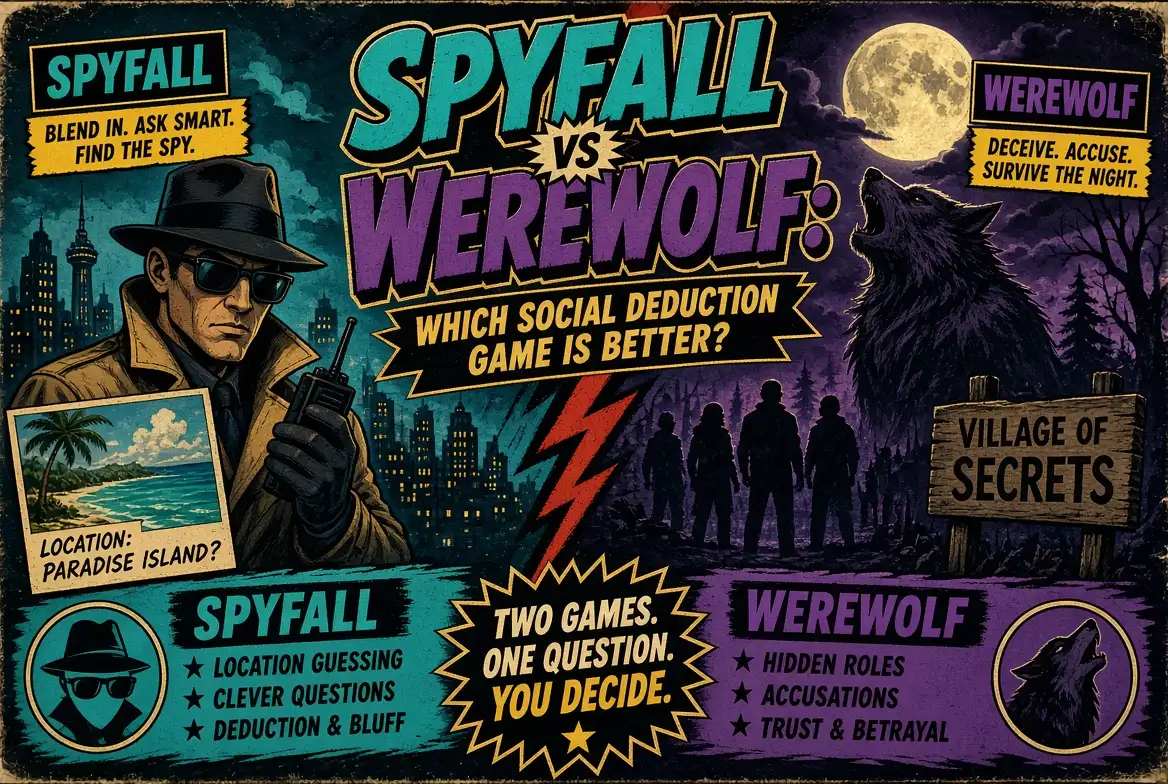
Neither game is better for everyone. Any honest answer to the Spyfall vs Werewolf question depends on how many people turn up, how much time you have and how much drama your group enjoys. Here is the quick version.
- Choose Spyfall for around four to eight players, short rounds and a game where nobody sits out.
- Choose classic Werewolf for bigger groups of seven or more who have a host and a whole evening to spare.
- Try One Night Ultimate Werewolf if you want the werewolf flavour in about ten minutes without a moderator.
What Is Spyfall?
Spyfall is a party game about asking the right questions without giving the game away. Everyone except one player knows where they are, and the person who doesn’t is the spy. It takes two minutes to explain, which is half its charm.
How a Round of Spyfall Works
At the start of each round, every player sees the same secret location, such as a hospital, a bank or a railway station. One player sees only the word “Spy” and has no idea where everyone else is. Players take turns asking each other questions, proving they know the location without making it obvious.
Our online version adds a “no retaliation” rule, so you can’t fire a question straight back at whoever asked you. Anyone can put a suspect up for a vote at any point, and as our full Spyfall rules put it:
“The vote must be unanimous to indict the suspect: if any player votes no, the round continues as it was.” (Spyfall Game Rules, spyfall.live)
Meanwhile, the spy can stop the round at any moment, reveal themselves and guess the location. That keeps the pressure on both sides until the very end.
Where Spyfall Came From
Spyfall was designed by Alexandr Ushan and published by Hobby World in 2014, with Cryptozoic Entertainment publishing the English editions. The original box plays three to eight people and sets each round at eight minutes. Its publisher summed up the whole idea in one line:
“It’s really simple! All players, except one, get cards with the same location: a casino, a traveling circus, a pirate ship or even a space station.” (Hobby World)
A sequel, Spyfall 2, followed in 2017 with 20 new locations, room for up to 12 players and the chance of two spies in the same round.
What Is Werewolf (and Is It the Same as Mafia)?
Werewolf is the grandparent of the whole social deduction genre. It is more a folk game than a single product, with countless versions and house rules. If you played Mafia at school or uni, you already know it.
How a Game of Werewolf Works
A moderator, or narrator, secretly hands out roles. The werewolves know each other, villagers only know their own card, and special roles such as the Seer add information. The game then cycles through two phases.
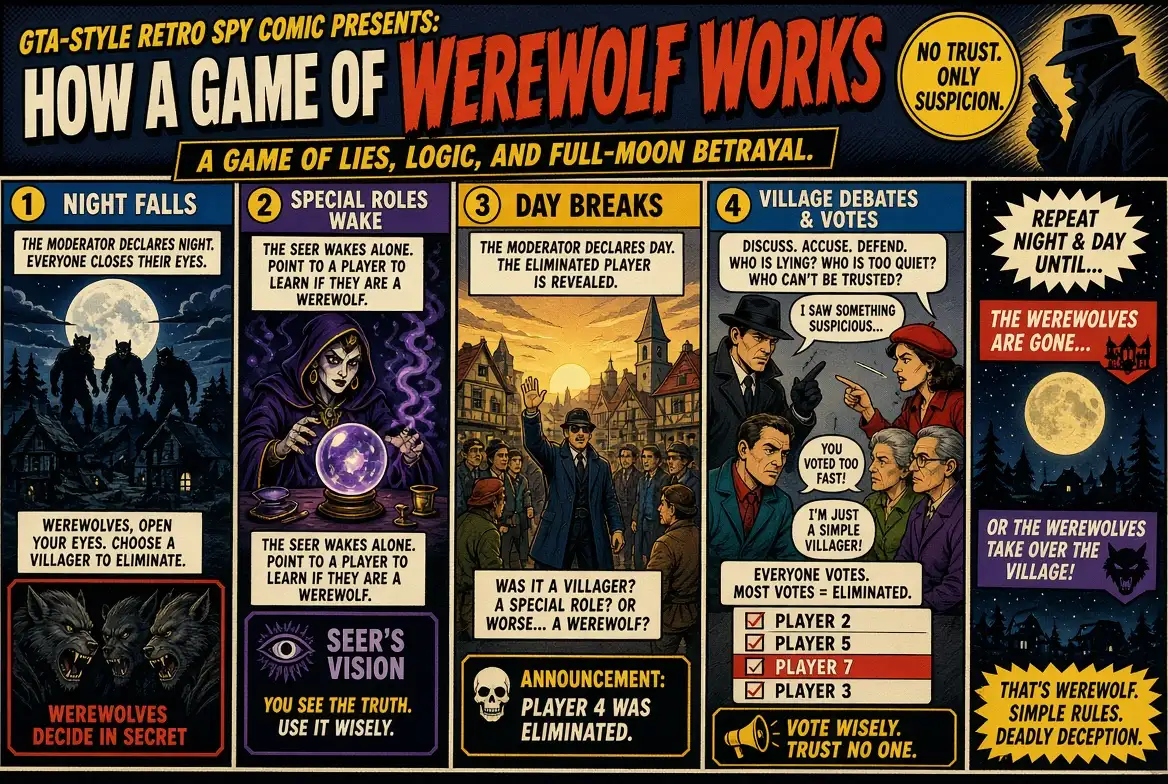
The villagers win by removing every werewolf. The werewolves win once they match the villagers in number.
From Moscow Classroom to Global Party Game
The original game, Mafia, was created in the mid-1980s by Dmitry Davidoff, a psychology student at Moscow State University. It is usually dated to 1986, although Davidoff himself placed the first game in spring 1987. It spread through dormitories and summer camps, then across Europe and the US.
In 1997, Andrew Plotkin gave it the werewolf theme most English speakers know today. Looney Labs, whose team learned the game from him, describes the moment simply:
“He thought a better theme would be werewolves and he created the basic roles of Werewolf, Villager, and Seer.” (Looney Labs FAQ)
So when people ask about Werewolf vs Mafia, the answer is easy: same game, different costume.
Spyfall vs Werewolf: Side-by-Side Comparison
Numbers settle a lot of arguments before they start. The table below compares Spyfall with classic Werewolf and its quickest modern spin-off, One Night Ultimate Werewolf. Player counts and timings come from the publishers and the most widely used rules.
| Spyfall | Classic Werewolf / Mafia | One Night Ultimate Werewolf | |
|---|---|---|---|
| Players | 3–8 in the box (up to 12 in Spyfall 2) | At least 6, best with 10+ | 3–10 |
| Length | 6–10 minutes per round | 15–90 minutes per game | About 10 minutes |
| Moderator | Not needed | Needed, and they usually sit out | Not needed (an app can narrate) |
| Elimination | None | Yes | None |
| Main skill | Asking and answering questions | Debate and persuasion | Logic and bluffing |
| Who lies | Only the spy | The werewolves (and some brave villagers) | Potentially anyone |
| Learning curve | Very low | Moderate | Low to moderate |
| Play online | Free on spyfall.live | Apps and online versions | Official app as narrator |
In practice, Spyfall slots neatly between other plans, while classic Werewolf tends to become the plan.
Key Differences That Change the Feel of the Night
On paper, both games share the same skeleton: a hidden minority, a suspicious majority and a vote. At the table, though, they create very different evenings. These four differences matter most whenever the Spyfall vs Werewolf choice lands on your coffee table.
Questions vs Accusations: How You Hunt the Traitor
In Spyfall, information comes from questions about a place. You might ask “What would you usually wear here?” and listen for an answer that sounds off. The skill is giving a reply that convinces your friends without handing the spy the location on a plate.
Werewolf works differently, because there is no shared secret to probe. Instead, you study what people claim, who they defend and how their story changes after each night. For the Spyfall side of things, our guide on how to spot the spy breaks down the tells worth watching.
Nobody Sits Out in Spyfall, but Werewolf Has a Graveyard
Player elimination is the biggest practical difference between the two games. In Werewolf, being “killed” on the first night can mean watching from the sidelines for half an hour or more. Some people love spectating; others quietly reach for their phones.
Spyfall never benches anyone. Everyone asks and answers every round, so even the quietest guest stays involved.
One Liar vs a Pack of Them
Spyfall usually has just one spy, so everyone else is telling the truth, just very carefully. Werewolf has a team of wolves who know each other, which brings alliances and genuine betrayal. That gives Werewolf its depth, but it also raises the temperature.
Werewolf debates can get heated, and the final reveal stings when a close friend has lied to your face all evening. Spyfall stays lighter because only one player bluffs, inside a quick, structured round. 🐺
Who Runs the Game?
Classic Werewolf needs a moderator to call the phases and keep the story moving. That person usually doesn’t play, so you need a willing volunteer who enjoys a bit of theatre. One Night Ultimate Werewolf solves this with an app that narrates.
Spyfall runs itself. On our site, the browser deals roles, picks the location and keeps time, so the host plays too.
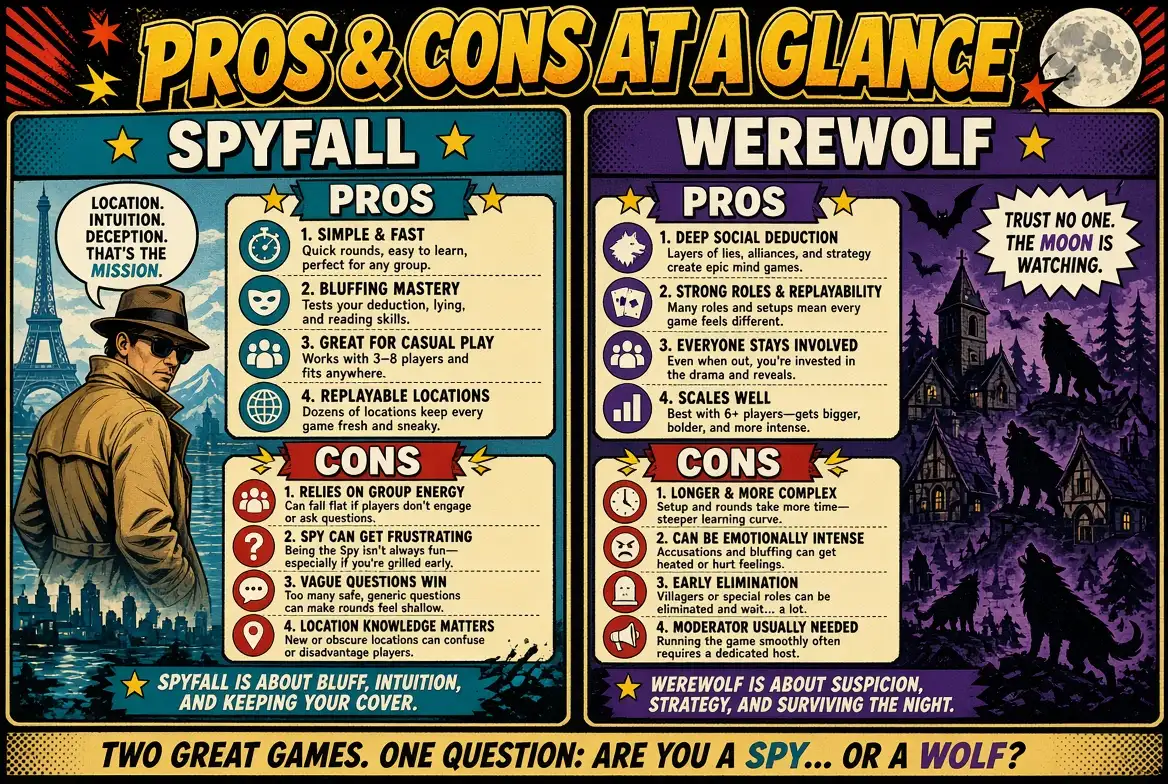
Pros and Cons at a Glance
Short on time? This is the section to screenshot for the group chat. Both games have clear strengths and quirks that suit some groups better than others.
Which One Should You Choose? (Verdict by Situation)
The best way to settle the argument is to start with your group, not the game. Below, we match common games-night scenarios with the option that tends to work best.
Small Groups of 3–5 Players
Spyfall is the stronger choice here, especially with four or five players. Ushan himself has said it really comes alive from four players. Classic Werewolf struggles here, though One Night Ultimate Werewolf is a solid alternative. If there are only two of you, take a look at our guide to playing Spyfall with two players.
Big Parties of 8 or More
This is where Werewolf earns its reputation. With ten or more people, the accusations get louder and the reveals bigger. Spyfall 2 stretches to 12, but the designer has noted that past nine players, rounds drag and some barely get asked.
Family Games Night and Mixed Ages
Spyfall usually wins with families. Nobody gets “killed off”, the rules fit on a postcard, and the laughs come from odd answers rather than betrayal. Both editions are aimed at teens and adults, so check the box suits your youngest player. More detail is in our piece on whether Spyfall is good for family game night.
Friends Online or Split Across Cities
Both games can be played remotely, but Spyfall is far easier to set up. Open a video call, start a room on our site and share the code, and everyone sees their own card privately. Werewolf works online too, usually through apps or a moderator sending roles by private message.
The Overall Verdict
So who wins the Spyfall vs Werewolf showdown? Spyfall takes it on accessibility, pace and keeping everyone involved, while Werewolf wins on scale, drama and depth. Many groups play both: Spyfall as a warm-up, Werewolf once the full crowd arrives.
Our rule of thumb: under eight people and under an hour? Deal Spyfall. A big crowd and a whole evening? Wake the werewolves.
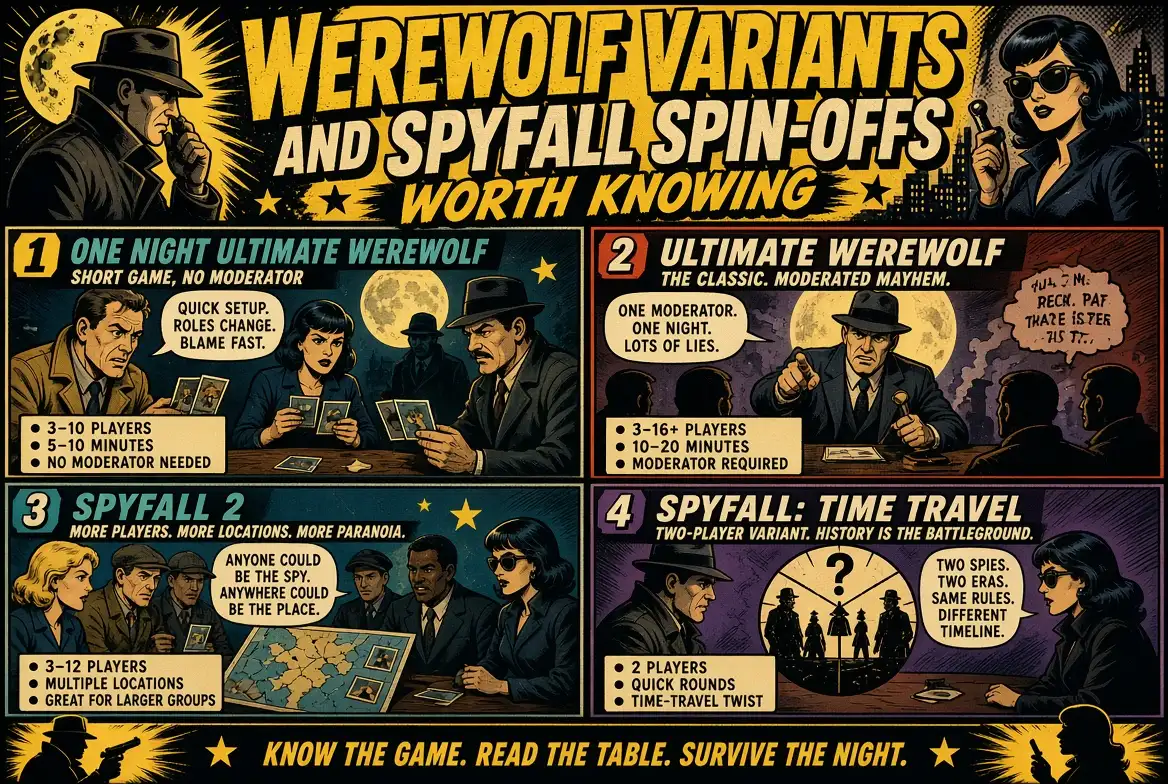
Werewolf Variants and Spyfall Spin-Offs Worth Knowing
Neither game stands still, and both have spin-offs that fix their biggest weaknesses. If you like one game but not the whole package, one of these could be your middle ground.
How to Play Spyfall Online in Two Minutes
If this comparison has tipped you towards Spyfall, you don’t need to buy a box to try it. Our free browser version runs on phones, tablets and laptops, with nothing to download. Here is how to start.
- Open the Spyfall online homepage and press Start Game.
- Choose your game settings.
- Share the room code with your friends.
- Everyone checks their own screen, and the first player asks a question.
Before your first round, have a look at our list of the best Spyfall questions. Then read up on how to win Spyfall as both the spy and the detectives.
Final Thoughts
However the Spyfall vs Werewolf argument ends at your table, the real winner is a room of friends trying not to laugh while someone bluffs their way out of trouble. Spyfall gets you there in minutes; Werewolf builds a slower, bigger payoff. If you fancy a quick round tonight, start a free game of Spyfall and see who cracks first. 🎲
Frequently Asked Questions
These are the questions we hear most often from players weighing up the two games. We have kept the answers short.
Is Spyfall like Werewolf?
Both are hidden-role games where a group tries to unmask a liar. The difference is that Spyfall uses questions about a secret location, has one spy and never eliminates anyone.
Are Werewolf and Mafia the same game?
Yes, they are essentially the same game with a different theme. Mafia came first in the mid-1980s, and Andrew Plotkin reworked it as Werewolf in 1997.
How many players do you need for Werewolf?
Classic Werewolf needs at least six players and really shines with ten or more. With fewer, try One Night Ultimate Werewolf (3–10 players).
Can you play Spyfall with 3 players?
Yes, the original box supports three players, but the game gets much better from four upwards. Our online rules suggest four to twelve; see how long a round of Spyfall lasts for different group sizes.
Which is easier to learn?
Spyfall is easier by a distance, with just two roles and one simple loop of questions. Werewolf adds a moderator, night phases and special roles, so newcomers need a game or two to settle in.
Can I play Spyfall online for free?
Yes, you can play for free right here on spyfall.live. Create a private room, share the code and play together in person or over a video call.

Born and raised in London, Paul is the Digital Strategist and Content Manager. With a strong background in multilingual content creation, he works behind the scenes to ensure players worldwide have a seamless, engaging experience while hunting down spies. When he isn’t optimizing website content or testing new web features, you can usually find Paul training at his local MMA and boxing gym, or putting his own social deduction skills to the test in a fast-paced round of our social deduction game.